
Last weekend, hundreds of thousands of people in Germany demonstrated that it is possible to oppose a future of poverty, violence and war. Following the horrific victories of the Alternative for Germany (AfD) party in two state elections, the media and politicians were quick to blame workers and East Germany’s communist past for supposedly innate illiberal tendencies, as if the shift to the right were not part of the very history of neoliberal Europe. We already know who is responsible for the rise in racist and patriarchal discourse, the spread of authoritarianism in workplaces and schools, prioritising the interests of capital over everything else, denying the climate crisis and legitimising war as an acceptable means. We also know who is responsible for the resurgence of antisemitism, which was first instrumentalised to suppress protests against the genocide in Palestine and is now being used to oppose calls for more affordable housing in Berlin. Those who decry the return of the Nazis while hoping to ‘normalise’ them, and perhaps even govern alongside them, are the very people who have paved the way for their success.
And yet, despite the dramatic situation, last weekend showed that it is still possible to build broad opposition from below to this grim present. All across Germany, voices have been raised against the current attacks on our lives: nationwide protests against social spending cuts and wage reductions; the Rheinmetall Entwaffnen (Disarm Rheinmetall) campaign’s actions in Hamburg; and student strikes against military conscription. Therefore, the past weekend was the first mass mobilisation against Friedrich Merz’s government and the first reaction to the AfD victories, together with their world made of violence and militarism. It offered a significant glimpse of how a connection between fighting the wage regime and the war scenario can be achieved. However, it also revealed the immense challenges that still lie ahead.
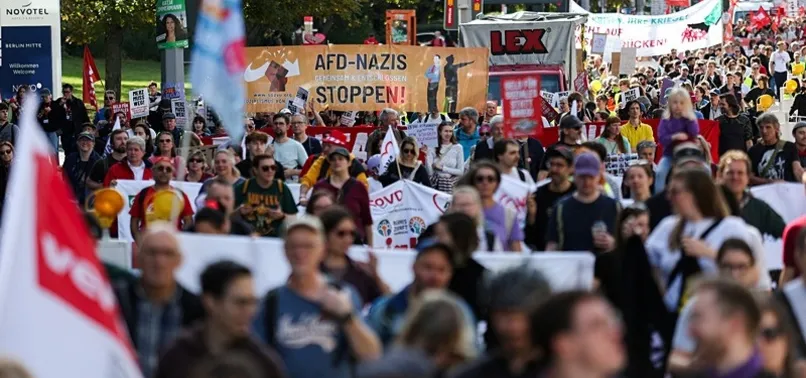
On Friday, high school students in over 100 cities went on strike for the fourth time this year to protest against military service. They are refusing to become cannon fodder and are rejecting a future of poverty and precarity. As they put it, ‘School strikes and social protests go hand in hand!‘ Meanwhile, from the 23rd to the 26th, various protests against the NATO manoeuvre took place in Hamburg. This manoeuvre represented an attempt to prepare a whole city for war. Through a camp, actions and a demonstration, the alliance showed that people are unwilling to accept the logic of war. On Saturday, the students and the anti-NATO protesters joined the 175,000 people who took part in demonstrations organised by the German Trade Union Confederation (DGB) against social cuts. In more than 15 cities, workers took to the streets to demand an end to the war on their wages. Although the unions still refused to discuss war and militarism — even hoping that the arms industry would restore the jobs they had failed to protect from deindustrialisation — the link between the threat of a global conflict and deteriorating working and living conditions was there in front of their eyes. It was evident in the numerous signs calling for an end to spending on rearmament and in the many speeches that clearly demonstrated the connection between war, general impoverishment and increasing exploitation. While trade unionists reminisced about social democracy and rising productivity, a far more complex and diverse crowd stood before them, openly refusing war and its consequences. In their speech, organisers from the Unkürzbar (Uncut) Alliance clearly pointed to this connection: ‘The fight against social cuts must also be a fight against the AfD and rearmament!‘
It is not our responsibility to prove the existence of a large resistance movement. We are aware that it is only in the making. Instead, we want to highlight that the protests demonstrate the interconnectedness of the current attacks and the need for a joint response to them. Transnational disorder is rendering the model of social partnership obsolete, and organising the scattered opposition to the war scenario is our future challenge. As our comrades from Rheinmetall Entwaffnen have said, the fight against militarism and the fight against social cuts must go together. The struggle against the European wage regime is part of the struggle against a Europe at war. The concrete organisation of our transnational struggles will depend on finding new ways to articulate the struggles against the European wage regime within a Europe at war. This is what may turn a possibility into reality.