
Report of the meeting ‘Europe at War’, Cologne 28 February 2026
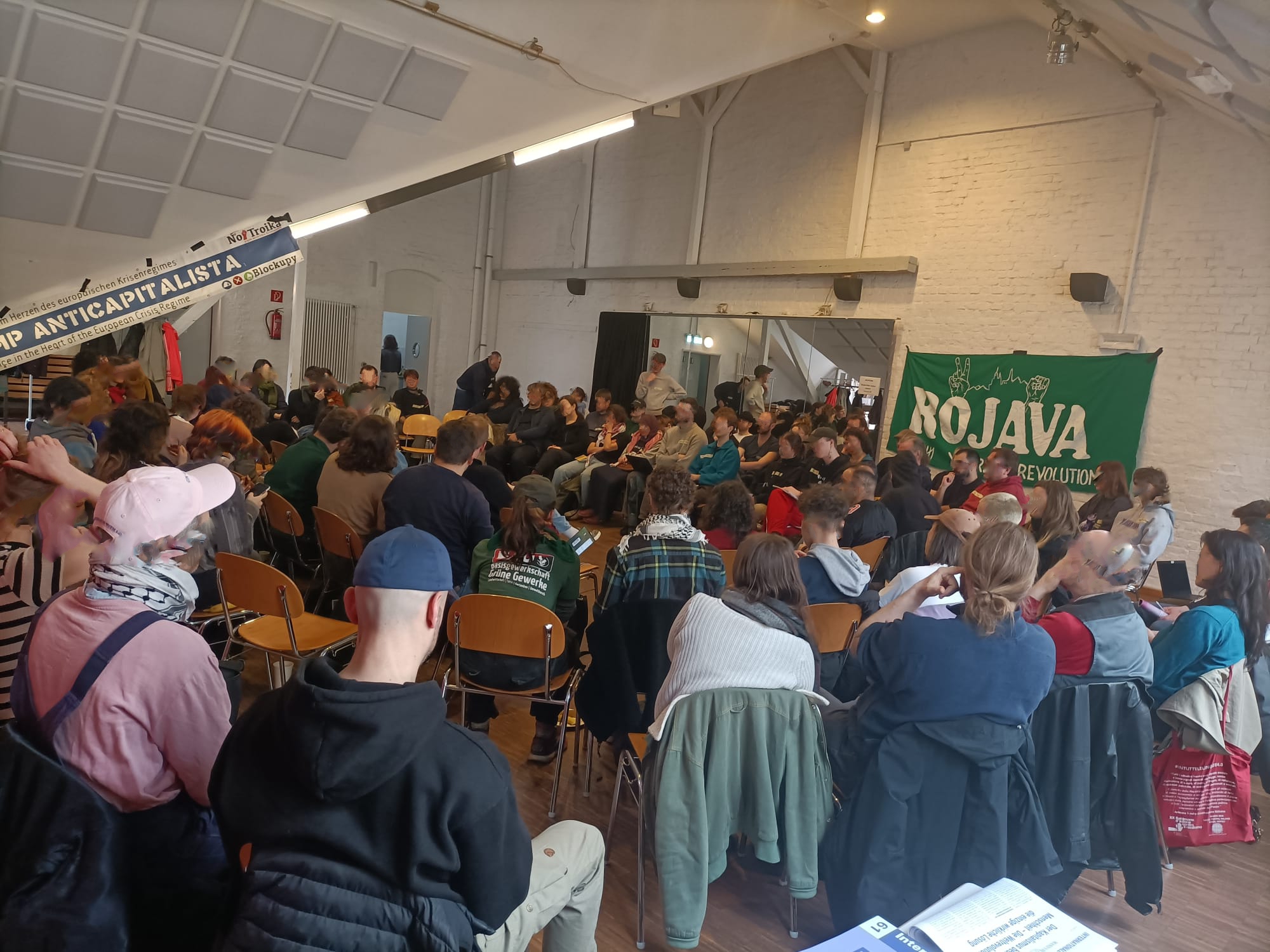
On February 28, over 100 activists, students, workers and trade‑unionists from across Europe and beyond — we came from Spain, Turkey, Portugal, Kurdistan, the UK, Italy, Greece, Romania, France, Ukraine, Russia, Austria and Germany — met at the first “Europe at War” assembly in Cologne. It was the day of the US and Israeli attack on Iran, another confirmation of the present of war that is surrounding us. As a member of the Iranian Roja collective, joining from Paris, put it: “war is presented as the solution, but military intervention is not liberation. You cannot bomb your way to democracy. Those who profit from war are never on our side.”
The assembly opened with a decision to put down the rhetorical weapons we too often use against one another and to build a different way of talking about war — one that refuses geopolitics or campism (whether over Ukraine, Gaza, Venezuela or elsewhere). Falling into geopolitical fronts has prevented open discussion of what is new in our situation and blocked grassroots solidarity with those suffering bombs, starvation and freezing. Three years ago, we would not have been able to speak so openly about war; now there is an urgent need to come together and map this new reality.
What does “Europe at war” mean? The intention of the phrase is not to reproduce Eurocentrism; Europe at war is of course connected to and with the world at war, and we do not aim to separate Europe’s struggles against the war from those elsewhere. Besides, Europe is not a single block: living realities differ sharply — people under fire experience things differently from those who are not. Students in Germany, migrant workers in Spain, Ukrainian refugees, farm laborers inside and outside the EU, and members of Palestinian or Kurdish diasporas all face distinct effects. The effects of war are felt across the continent in varied but interconnected ways. Treating “Europe at war” as a common political frame lets us connect across these differences and trace together the cracks and tensions where intervention is possible and ask ourselves how to bridge the experiments of strike against the war that have been happening throughout Europe.
The immediate effects of Europe at war
At the assembly, it became clear that for some of us, Europe at war means living through the reality of a war in Europe. Comrades from Ukraine and Russia reminded us of the many affected civilians and the political prisoners in Russian prisons. Comrades based in countries that share borders with Ukraine – Romania and Poland –, reported how militarization is becoming materially visible through expanded military infrastructure, including plans for the second-largest base next to Rammstein in Romania. Kurdish comrades living in Turkey highlighted how wars are not only fought across internationally recognized frontlines but can also function as permanent domestic regimes. They stressed that in Turkey, war has become an organizing principle of governance: political Islam, patriarchy, and securitization combine into a war from state against society.
In our discussions, we learned that all over Europe, political actors and institutions exploit existing social conditions to manufacture fear. The distance to the frontline is not necessarily the primary, but still an important factor that determines how fear can be instrumentalized. In Romania, militarization is justified as a necessary response to the Ukrainian border and wider security concerns, and reinforced by a broad consensus around NATO alignment. In Poland, fear is instrumentalized in a double sense: not only is Russia portrayed as a threat, but migrants are also turned into harbinger of crisis and insecurity. At the same time, migrant workers from Ukraine are disciplined through precarity and the threat of being sent back home. In the UK, the threat of war is less immediate, but surveillance and domestic security concerns remain central, especially in relation to transnational supply chains and data flows.
Europe at War beyond the battlefield
Measures taken by governments across Europe are increasingly operating through force, but also more obscured, indirect measures. Public budgets shift to armaments at the expense of welfare, education and public services. In Romania, for example, young people and students are facing deep cuts in education and harsh austerity measures, even as the state raises military spending to 2.5% of GDP and receives €16 billion from the EU for rearmament. In Germany, the reintroduction of military conscription is on its way. Especially in Italy and Germany, the military has increased its presence in schools.
In a less obvious way, the assembly discussed how governments introduce pronatalist and disciplinary social policies to shore up reproduction amid demographic and economic strain. In France, political rhetoric increasingly links war and reproduction, with Macron calling for a “demographic rearmament” in response to declining birth rates, folding natality into the language of national preparedness and sacrifice. Schools have implemented drills, tightened rules that normalize compliance; governments are increasingly shaping the curricula. Hospitals adopt triage routines that make scarcity routine. Factories and warehouses use precarious contracts, speed-ups and surveillance to discipline labor. Public spaces are increasingly policed and restricted; border policies and criminalization push migrants into danger.
A war on re/production and a new labor regime
Remilitarization restructures production and social reproduction together. Industries are retooled and supply chains realigned toward defense procurement; labor is reorganized, hours extended and exploitation intensified, with migrant workers disproportionately affected. A comrade from the farm workers union in Germany stressed that the effects of war and climate change are an increase in weed prices, as seen in the case of Ukraine and felt by poor people all over the world. At the same time, the promise of secure employment in the military-industrial sector is drawing workers away from agriculture; for instance, a farmer who learns farm mechanics may now choose a work at Rheinmetall because it potentially offers more stable working conditions.
The connection between everyday experience and war can be obvious – the reintroduction of military service in Germany, EU rearmament plans, natality policies framed as “demographic rearmament” in France – or more hidden and indirect, as when attacks on wages, benefits and dissent are framed as necessary sacrifices. Military recruitment advertised as secure, well‑paid work makes sense only in an environment of precarity, poverty and uncertainty: poverty becomes a tool to normalize war, luring people into the war effort by preying on economic distress. Cuts to welfare and public benefits during the pandemic were reframed as necessary adaptations to a new era of sacrifice. Where there appears to be popular support for war preparations, there is often instead a context that forces people to choose between precarious living conditions and work tied to the military-industrial complex. Europe at war is thus also a Europe where the material ability to distance oneself from conflict is unequally distributed.
As part of this, all over Europe a new labor regime is being imposed, with reforms lengthening the working day, the working week and postponing the retirement age. Wages are severely shrunk by inflation, forcing people to work more to be able to make ends meet. War seems to be dictating a new labor regime, with different forms and rhythms in different countries, but also with some clearly recognizable common threads. Workers are forced to work more for less money, hospitals and schools are understaffed, migrants are considered more and more as disposable labor force, women are asked to sacrifice at work and at home, migrant farmworkers are seeing their wages heavily curtailed. It is predictable that some will seek more secure income at arms factories or in the armed forces when alternative livelihoods vanish. The political task is not to shame those choices but to intervene on the underlying conditions that can make military work attractive: precarity, poverty and unemployment.
These issues pose an additional problem that relates to the relationship with trade unions, that is experienced in different ways, sometimes across Europe, and sometimes even within one country. Sometimes, as in the case of the German union IG Metal evidenced by a comrade in the assembly, the refusal of war is put after the priority of defending jobs. This means that the union has been endorsing some proposals for military conversion of industrial plants in crisis to secure the jobs of those who work there. How to engage with organizations that, with the aim of defending jobs, end up supporting rearmament, without in turn being able to build a wide opposition to the general worsening of the working and living conditions that is becoming widespread throughout Europe? Some of us argued for a concrete position on the fact that no worker is in the long run going to profit from the war. Not only because weapons once produced will be used, but also because the militarism accompanying war demands sacrifices, poverty, repression of dissent and the attack on the negotiating power of unions themselves. At the same time, the experiences of the recent massive strikes against the Palestinian genocide in Italy or in Spain as they were described in Cologne have seen hundreds of thousands of workers pushing their own union representations to more decisive anti-war stances, showing us that there is not necessarily a political alignment between unions leaders and the workers they represent.
How to struggle in a Europe at war?
Europe at war means also to openly discuss how to build wider alliances to promote struggles against the war. War cannot be only a preoccupation of anti-militarists or a moral issue. War is a problem for everyone now opposing exploitation, oppression, racism, authoritarianism. War is the new context in which we need to organize ourselves, requiring from us an effort in connecting several fields of intervention and in radically innovating the practices of the anti-militaristic tradition. The strikes in Italy and Spain against the genocide in Gaza, the student strikes in Germany and the organizing of Ukrainian workers in Poland, the protests in Greece against the labor reforms, and more recent initiatives as No Kings mobilizations, show that things are moving, and give some hints on the direction we can look at. Building our picture of Europe at war means rooting antimilitarism within society and transforming it in the face of new challenges. We know that these are big problems and that developing a common transnational strategy requires time. And at the same time, we know that it is urgent to act. In this direction, we want to support existing initiatives against war in all its forms and in particular foster communication between them. Secondly, we plan to organize further meetings that focus on specific aspects of what Europe at war means.
We want to build our own map of potential connections, we want to give the lie to the rhetoric of a generalized popular support to the war efforts, we want to put an end to fear. Our map of Europe at war will not be designed according to geopolitics, but it will be composed by the vocal as well as hidden resistances and struggles of those who are paying the highest price from the war. For now, the transnational chaos of war appears in the shape of violence, death, borders, economic crisis. Yet at stake there is the possibility to turn the cracks and signs of refusal into a transnational politics of peace: a project of liberation that turns the very causes of war into a field of common struggle and organizing.