
Conscription after neoliberalism
After years of professional armies and promises of peace, military conscription is making a comeback in Europe. On June 6th, during the celebrations of the 11th German Armed Forces Day, the German Minister of Defense, Boris Pistorius, declared that it is important that “soldiers are firmly rooted at the heart of society”. Sure enough, statements such as this, sounding like a threat coming back from the past, are increasingly more common as militarism becomes Europe’s official ideology across party affiliations and national borders. The German government’s plan to build up the biggest army in Europe was followed by the introduction in January of a voluntary military service, with the target of raising the number of active soldiers from 185.000 to 260.000. Starting from September, France will start a new national service, a ten-month voluntary and selective service in support of the French army aimed at enlarging the pool of reservists. Belgium did something similar last November, with the introduction of a one-year military service, and even the Italian Minister of Defense has spoken about introducing voluntary conscription in order to enroll 30.000 new soldiers.
Despite the spreading nostalgia and the everlasting wishes of politicians to impose what Rosa Luxembourg called the “cadaveric obedience of the soldier”, a full-scale militarization of society, as in previous world wars, with a mass army and drafted citizens, seems beyond the possibilities for many European states facing the current scenario of transnational chaos. The war still imposes its sacrifices on workers, migrants, women, and LGBTQ+ people and a death toll that is always there to remind us that state power is grounded on piles of corpses. But as the war is affecting the living and working conditions of millions of people way beyond the battlegrounds, the new forms of military draft – often implemented with little success – still rely more on incentives than on sanctions, more on individual “self-valorisation” than on the duty to serve the nation, more on worsening material conditions than on patriotism, and more on granting status privileges than on citizens’ responsibility. Despite the chauvinist propaganda, the construction of “existential enemies” and the threats to reintroduce compulsory conscription, national armies after neoliberalism are trying to enroll poor individuals or subjective identities by promising economic gains or political recognition. Conscription plans are therefore deeply intertwined with the European wage regime. After years of falling salaries, dismantled welfare, poorer education and rising disparities, military conscription appears as both the phantom of the nation state and the reminder of the necessary sacrifice of those living on their wages. The risk of war is therefore resting more heavily on the shoulders of those for whom “there is no alternative” after decades of neoliberal restructuring. All of this poses a fundamental challenge for movements that want to organize against Europe at war and its bleak future.
Wages of war
Europe’s Eastern border is where the new volunteer-based army clearly relies more on the worsening material conditions of years of neoliberal policies. Poland is the European country that is spending more of its GDP on rearmament and the major recipient of the loans coming from the SAFE programme, the European defense financial instrument. Compulsory conscription was suspended in 2009 by a constitutional amendment, but since 2024, a one-month basic voluntary military training programme has been implemented. After its completion, soldiers can choose either to be transferred to professional military service or to become reservists. Clearly, it is not only the glory of serving the nation that attracts the new soldiers, but the 6500 zloty per month – approx. 1500€ – plus food and accommodation against a minimum wage of 1100€. Moreover, as in many other countries, the training programme gives priority to employment in public administration. Therefore, while the European loans dedicated to rearmament will drain more public money and foster new austerity measures, for youths, the army is presented as the viable option to escape a future that looks increasingly grim.
The same economic blackmail is used in Romania to induce people to join the army. At the beginning of this year, the new pro-EU government of Nicuşor Dan introduced a 4-month voluntary military service, with the aim of increasing the military personnel and reducing the age of reservists. The wage consists of more than 4000 lei per month plus a final lump-sum payment of three monthly wages, for a total of 42000 lei – approx. 8200€ – against a minimum wage of 780€, which goes down to 500€ for young people, those to whom the programme is addressed. The message is clear: in a moment where wages are barely enough to make ends meet, the only possible way in which young workers can aspire to mitigate the effects of the violence of poverty and precarity is to embrace the organized violence of the army.
In Belgium, where the government has recently cut unemployment benefits and increased the pension age, the new voluntary service offers the “lucky” 500 new conscripts selected each year no less than 2000€ a month and free transportation. In Germany, joining the Neuen Wehrdienst grants even 2600€ monthly, with an additional sum of 3500€ for getting the driver’s license. However, in countries like Croatia, where a two-month compulsory military draft was recently reintroduced after almost 20 years, new soldiers will get only 1100€ (plus benefits). Despite clear regional differences, which the war scenario is now reinforcing, a similar logic lies behind these new modalities of recruitment across Europe: one that grounds the attractiveness of conscription upon impoverished wages, increased exploitation, rising living costs, poorer working conditions and rising uncertainty about the future.
Life skills for dead soldiers
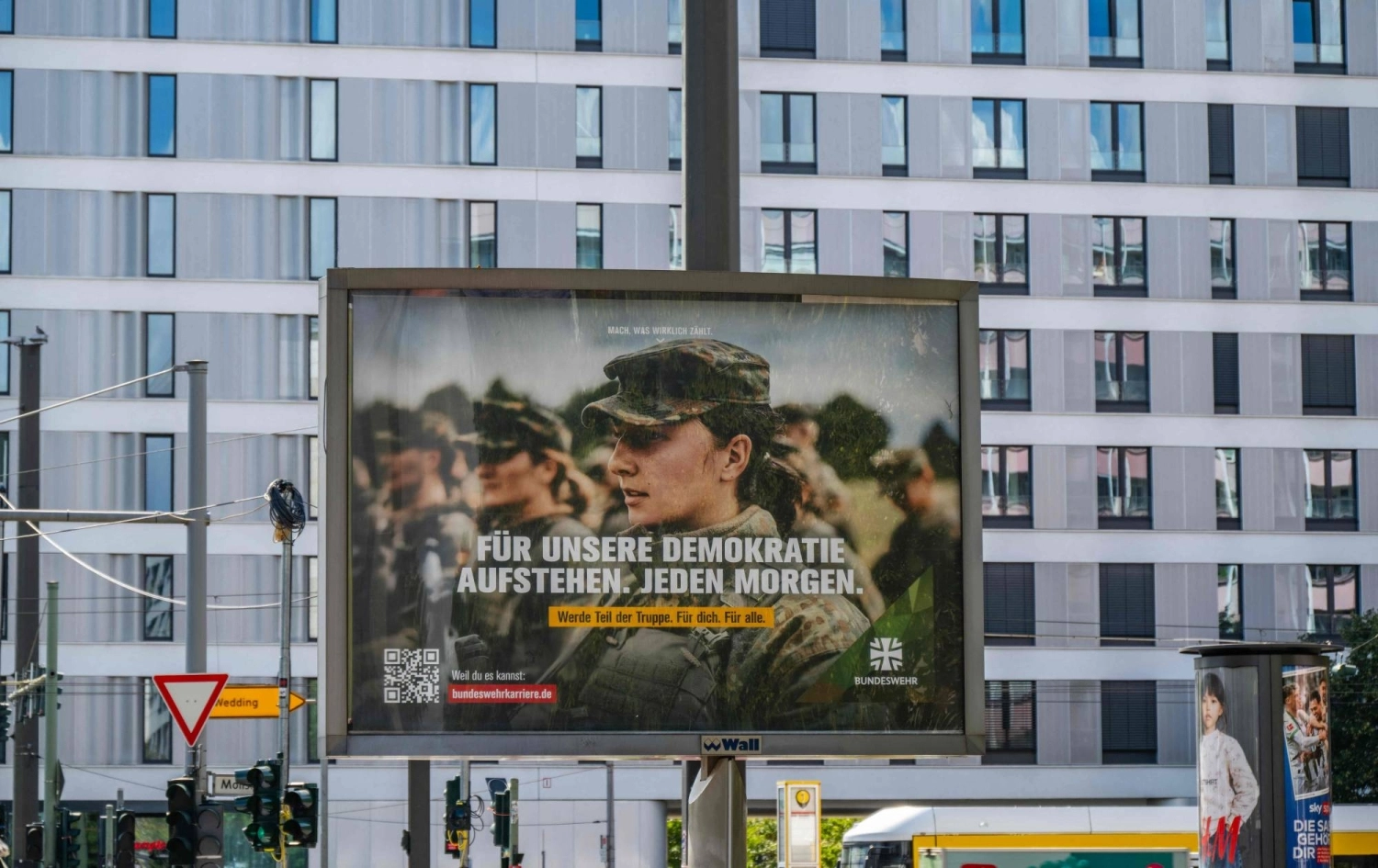
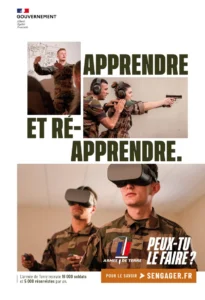
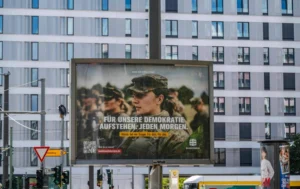
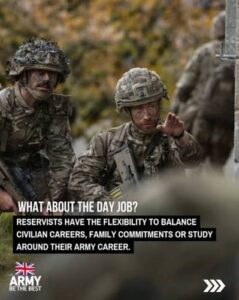
It is not only through the promise of a salary and other benefits that governments are trying to convince young people to enlist. In France, for example, after taking part in the voluntary service, people will be facilitated with the “Parcoursup”, the central portal that manages the applications to undergraduate programs in French universities and other higher education institutions. As good education is becoming more selective, expensive and competitive, national armies promise, in fact, to provide either preferential access to further education or the skills and competences for getting better jobs. The neoliberal language of education, made of “responsibility”, “skills” and “challenges”, is quite common in the armies’ advertisements that sound very much like LinkedIn posts. On the webpage of the Dienjaar Defensie – the one-year voluntary programme introduced in 2023 by the Dutch army – under a selfie with a bunch of smiling soldiers, one can find a ridiculous example:
“You will discover Defence from the inside, learning everything about teamwork, dealing with setbacks, responsibility, and trusting in your own strength. You will undergo training in military skills and learn to recognize and operate impressive weapon systems. One thing is certain: you will be challenged both physically and mentally to step out of your comfort zone.”
“The Defence Service Year is an intensive year in which you learn new skills and gain unique work experience that will be invaluable in your future career. […] It is a fun way to get acquainted with Defence, gain relevant work experience, and increase your chances of landing a great job”.
In sum, while universities in the Netherlands are facing major structural cuts (like in Germany and elsewhere), the army promises now to give you the bright future that years of neoliberal policies have cancelled, while also having fun! This highly individualized way of presenting military experience as a boost to your career clearly mirrors the logic behind neoliberal education, while trying to make the bitter pill – the fact of becoming cannon fodder – easier to swallow. However, what we are facing now is not a militarization of the education system, with military institutions replacing or getting in control of schools or universities. The vast presence of soldiers in schools, preaching love for the homeland or even how to handle a gun, like in the Polish “education for safety” programme, is rather an attempt to instill the neoliberal values of self-valorization and adaptation to the aggressive nature of today’s market.
Citizenship giveth, citizenship taketh away
The promises of a brighter future hardly conceal the social hierarchies that these new voluntary programs reinforce. While states directly involved in the war, like Israel, Russia or Ukraine, are using the promise of citizenship to recruit migrants to compensate for the widespread refusal of their nationals to enlist, EU countries still require citizenship to enter the army. Furthermore, proposals by some EU governments to exclude Ukrainian men of military age from any future extension of temporary protection, in an effort to meet Ukraine’s military needs, reveal how readily the promise of protection is subordinated to the imperatives of war and of restricting migrants’ possibilities to stay legally in Europe. In compliance with the sex division of citizens’ rights and duties, male and female citizens are called to join the army according to their different “natural” roles. In Germany, even if both sexes can access the new voluntary service, only men are obliged to respond to the questionnaire they receive when they turn 18. Although symbolically, this difference reproduces the old patriarchal mantra that nurtures militarism, that men are for war and women for the home.
But the alternative of a “gender-neutral” army is hardly a preferable one. In Denmark, where, starting from 2025, the “lottery-based” compulsory military conscription became gender-neutral, women have systematically reported experiences of harassment in the army. While the army remains one of the most patriarchal institutions, at the same time, “womanhood” is often presented today as an identity that can be employed both for the good of the nation and for individual self-valorization. As recited on the website of the Dutch Minister of Defense: “As a woman, you have everything it takes for a job in Defence. From tactical thinking, teamwork, and quick thinking to stamina and strength: we can put your skills to good use here”. While preaching the old values of obedience and loyalty to the nation and to the traditional hierarchies, neoliberal armies have to present themselves as “inclusive” of all genders and identities. Again, in the words of the Dutch Minister of Defense: “contributing to a safe and equitable environment for LGB TQ+ employees is our top priority”, “we ensure that everyone feels heard and supported”. Claiming to protect and valorize vulnerable identities, by giving them recognition and future prospects of material gains, becomes the other way through which the army is trying to recruit an increasingly reluctant young generation.
School strikes and the transnational organisation
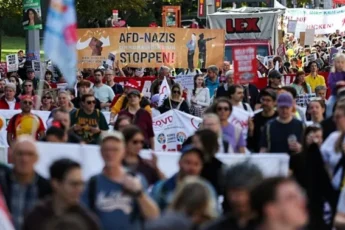
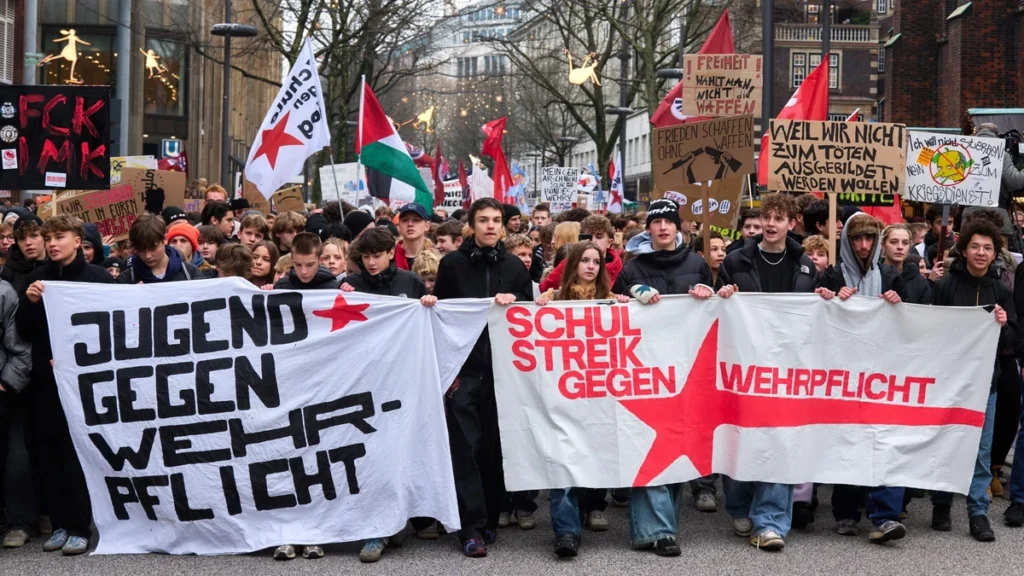
Right after the introduction of the voluntary military service in Germany, tens of thousands of German students took to the streets shouting “Nie wieder Wehrpflicht” – “Never again compulsory conscription!”. Since the beginning of the year, students have gone on strike three times against conscription, in what can be regarded as the largest collective refusal of the war and the social order that sustains it in the country. Precise data on responses to the conscription letters have not yet been published. We only know that around 24% of recipients did not reply and therefore will be fined 250€ (the new data just released show that the nearly 300,000 letters sent resulted in the enlistment of only 530 people nda). Different ways of refusing military service are gradually made difficult and invisible. After the number of objections to military service (enshrined in the Basic Law of Germany) has risen steadily over the last few years, the German government has now decided to turn the number into classified information.
The fact that politicians and the media repeatedly insist that voluntary conscription will be made compulsory if recruitment targets are not met suggests that the neoliberal strategy of encouraging enlistment through promises of a better future is not proving particularly successful. In a context where states are cutting spending on unemployment benefits, healthcare, and education, and where citizenship itself no longer guarantees social integration, the rewards offered by the military in exchange for one’s life appear insufficient to persuade many people to accept the deal. Although governments seem ready to resort to coercive measures, they also appear hesitant to do so, uncertain of the level of compliance they can expect.
This new situation, however, also poses new challenges for us. To make the refusal of conscription effective, it must be coupled with a refusal of the capitalist, patriarchal, and racist conditions that increasingly make military service appear to be a viable option. This means abandoning any moralistic approach that treats opposition to military service as merely a matter of individual choice or personal virtue. Recognizing that, in the dark times ahead, the ability to refuse war may itself be a privilege does not mean surrendering to the harsh realities of coercion and blackmail. Rather, coming to terms with the fact that Europe is at war and that military conscription is returning across the continent requires us to organize collectively. We must build the conditions for a broad and powerful strike against war itself, as well as against all the social, economic, and political conditions that sustain and reproduce it.