
Warsaw, 29.05.2026
We publish the report of a meeting that took place in Warsaw on the last weekend of May. Comrades from Interventionist Left (IL) Berlin visited the Workers’ Initiative (Inicjatywa Pracownicza, IP) in Warsaw for a joint discussion on the accelerating military spending in Europe and the resulting restructuring of states and societies around questions of security and defence, bringing the question of emancipatory politics under the threat of war to the fore. This exchange emerged from meetings organised within the TSS platform, particularly the Europe at War gathering in Cologne.
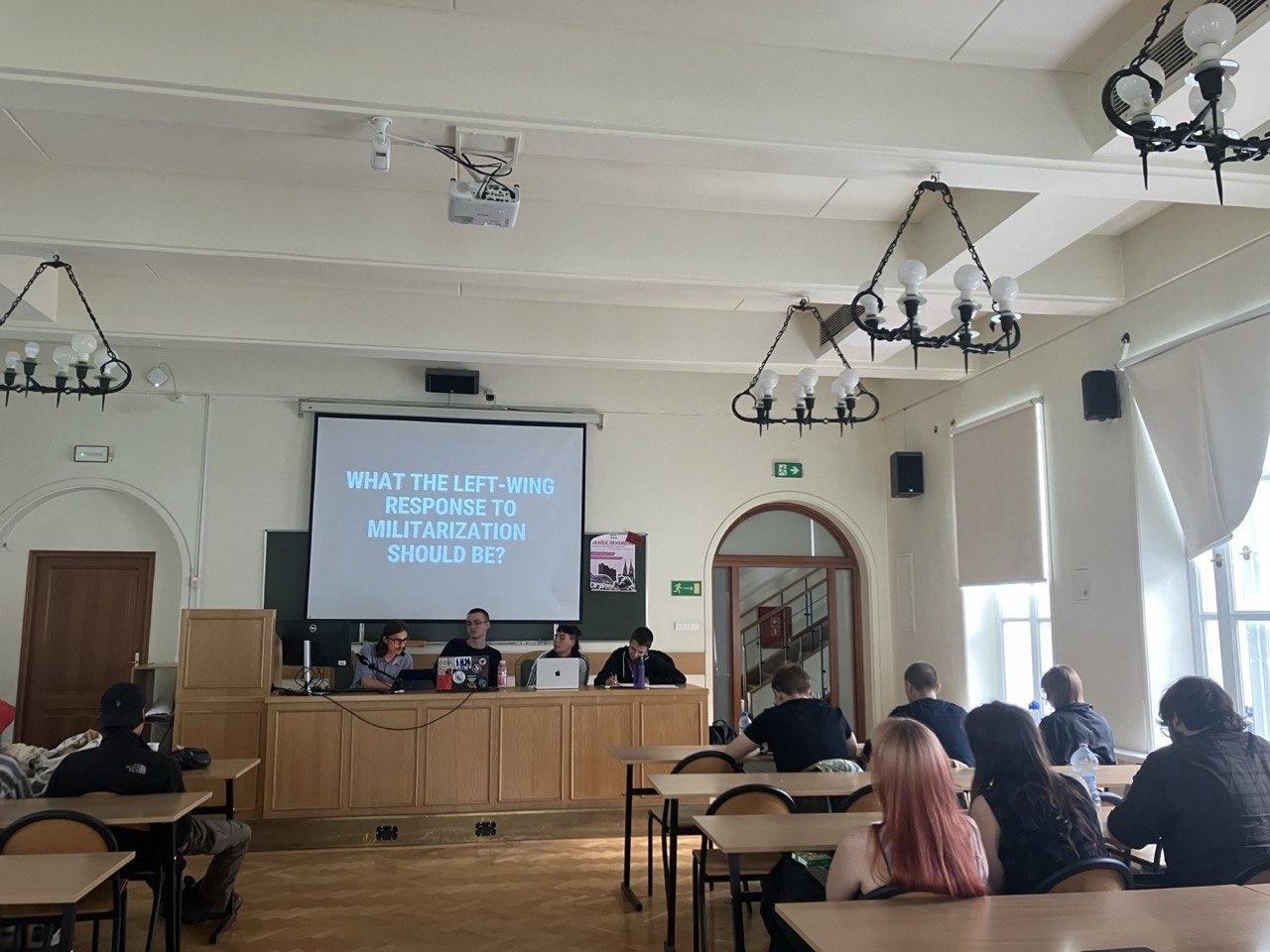
Joint Event at the University of Warsaw
The discussion, organized as a public event brought together students from groups active at the university, members of Workers’ Initiative Labour Union (Inicjatywa Pracownicza), Youth Group of the Workers’ Initiative (Koło Młodych Inicjatywy Pracowniczej) and comrades from IL Berlin.
Around 20 people attended and discussed militarization in Germany and Poland, focusing on its social consequences, the narratives used to justify military expansion, the groups most affected by these developments, and possible forms of resistance and cooperation.
Militarisation and Social Acceptance
In both countries, we are witnessing a heavy diversion of public funds towards military spending at the expense of healthcare and education, the expansion of weapon industries, and social war preparation. In Poland, which currently spends the highest percentage of its GDP on “defense” among all NATO countries, this trend is, much like in Germany, accompanied by growing inequality, legislative measures that normalize military priorities, and nationalist propaganda aimed at covering class division with the idea of “national interest”. Due to political narratives drawing on historical notions of a constant threat from “the east”, glorification of NATO, and visions of uniting all classes under the banner of a war regime where workers as well as giant multinational and domestic companies can benefit from the influx of funds pouring in from all sides, militarization is already deeply embedded in social consciousness. Extensive recruitment campaigns and advertising that present military service as a legitimate way of alleviating economic hardships are in Poland a daily experience, while only recently being reintroduced in Germany.
One important point concerned military registration, which was reintroduced only this year in Germany. In Poland, compulsory military service was suspended in 2009, but military registration remained mandatory for all men turning eighteen. Participants described this process as widely accepted and rarely questioned, even despite recent changes in the regulations that raised the maximum age for those classified as “fit for service” from 55 to 60 and loosened the requirements for being granted this category. Being classified as fit for service is often regarded positively, while visible opposition remains marginal.
The Difficulty of Anti-Militarist Organizing
The exchange highlighted the limited political space available for anti-militarist positions in Poland. Criticism of militarization or arms deliveries is often quickly associated with Russian disinformation campaigns, creating significant obstacles for political organizing.
Another obstacle to anti-militarist organizing, relevant beyond Poland, is that an effective movement for peace would have to be based on the mass involvement of the working class, but labor unions tend to focus on issues related to wages and working conditions and are often hesitant to take political stances.
Despite these conditions, participants identified substantial common ground in their analysis of current developments. Whether described through the concept of the military-industrial complex or that of a war regime, there was broad agreement about the processes currently reshaping European societies.
The discussion addressed a strategic challenge: How can a left-wing response to war be developed when military threats are experienced directly or perceived as such, and when war has already become a central organizing principle of public life?
Perspectives for Cooperation
One of the most important outcomes of the exchange was the identification of a shared interest in continuing discussion and cooperation around questions of militarization, war, and anti-militarist organizing. International workers’ struggles and workplace organising featured prominently in these discussions. Historical examples of transnational resistance to German and more broadly European rearmament after the Second World War were discussed as possible reference points for rebuilding international working-class solidarity today.
These and other examples show that, despite the tendency of many labor unions to strive for “apoliticism,” an organized labor movement against militarization is possible. During the meeting, we concluded that the first step toward convincing unions and workers to take political stances on war is to show how these political issues—which are supposedly separate from wages and working conditions—actually have a direct impact on workers’ material conditions right here and now. We are seeing this already in rising energy prices due to the Russian invasion of Ukraine or a U.S. attack on Iran. Although this impact manifests differently in various parts of the world, in India, for example, workers are already experiencing a serious food crisis due to rising LPG prices. Democratic control over production was also highlighted as a potential means of challenging the influence of the military-industrial complex and redirecting resources towards social needs.
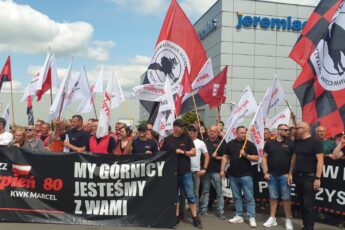
As a concrete next step, work has begun on a joint contribution for the TSS platform, and a follow-up online meeting is planned. Participants also discussed the situation at Jeremias (a factory owned by German capital) in Gniezno, where anti-union repression and the use of prison labour raise important questions about the relationship between labour struggles, repression, and contemporary forms of militarised capitalism.
The exchange highlighted both the difficulties and the necessity of anti-militarist organising under current conditions. Public support for military expansion remains strong, and political space for criticism is limited. At the same time, the discussion revealed substantial common ground in analysing militarisation and in the search for internationalist and class-based responses to war. Continuing dialogue, joint analysis, agitation, and practical cooperation therefore remain essential tasks for the period ahead.