

Interview with Nitesh Kumar Das – Amazon India Workers Union (AIWU), Gig Workers Association (GigWA), Amazon Workers International (AWI)
Laura Montanari
We are publishing this interview conducted with Nitesh Kumar Das, a member of Amazon Workers International and representative of the Amazon India Workers Union and the Gig Workers Association. The interview took place a month ago, with India caught in the middle of the Hormuz crisis, which severely affected workers and migrants: people do not have gas to cook and feed themselves. The situation is no better today. The ongoing war between the US and Iran, in India, means reverse migration from major cities as workers return to rain-dependent rural economies with limited savings, just ahead of the dry summer months.
In the country, migrant workers – both non-citizens and Indians from other regions – have always struggled to access LPG cylinders for cooking. They find it extremely difficult to register themselves on the government portal to get a cylinder under legal provisions. The lack of documents, limitation of the schemes, and now also the Strait crisis, push them to the black market. Domestic cylinders of about 14 kgs officially cost 913 rupees, and are now being sold in the black market for as high as 4,000 rupees each: a more than four-fold leap since the war began.
In March, protests have erupted in all the major cities, pointing to the war in which the Modi government is complicit, aligned with the US and Israel, while also using it as a way to justify an “inevitable crisis” out of its control. From the interview, the difficulties of organization among workers, especially in times of war and economic crisis, clearly emerge together with our urgent need to fight against the war in itself, instead of just focusing on its single, disconnected effects.
The Indian LPG crisis makes clear how material and extreme the consequences of war are on the workers and the migrants, even in those countries where bombs are not dropping.
TSS: What are the ongoing effects on workers in India coming from the war in Iran, and the current stalemate at the Strait of Hormuz?
Nitesh: This impact is indirect but very real. What we are seeing is how a geopolitical conflict translates into a cost-of-living crisis for workers. Because India depends heavily on LPG imports, disruptions in West Asia, especially around key routes like the Strait of Hormuz, have led to price spikes and panic in India’s informal markets currently. For workers, this shows up in very basic ways. Food becomes expensive, remittances fall, and daily survival becomes uncertain. In many warehouse clusters, particularly at Amazon, workers who were previously sending money home are now struggling to even afford their own meals.
Tss: You mean workers from India working in other parts of India who usually send money back home?
Nitesh: Yes. Many workers have migrated to India’s metro cities. Usually, in smaller cities, there are fewer job opportunities. The biggest share of the population migrates to the metro cities where there are jobs. And they send the money back. But we are seeing many instances in which workers struggle to send money because they cannot meet certain needs for the day. So the effect is not abstract; it is a direct squeeze on nutrition, savings, and dignity. In a way, it exposes how fragile workers’ lives are to global shocks over which they have no control. We have seen this in COVID, and now we are seeing it in the LPG crisis. Every shock has been taken care of by the workers, who are at the lowest level of the pyramid. And paradoxically, these are the same workers who make these big corporations and big industries function. But the system is designed in that way. The shock has always been taken by the workers, and COVID and the energy crisis are examples.
TSS: Why is this crisis hitting India more than other countries?
Nitesh: Because India imports 60% of its total LPG, about 90% of these imports are sourced via the Strait of Hormuz. It’s heavily dependent on them. So when there is a disruption, the shock gets transmitted quickly into prices. Even if the official supply remains stable, there is tension among workers due to panic buying. People get panicked, people get shocked. Also, 90% of India’s workforce is informal. And these are migrant workers, gig workers, and contract labor. They don’t have stable incomes, savings, or social protection at all. So even a small rise in everyday costs hits much harder here than in countries where workers have stronger safety nets.
In many countries, price shocks are cushioned through subsidies or direct support. In India, that support exists on paper, but migrants often cannot access it because welfare is tied to location and documentation. So the most affected group is also the least protected. These migrants move to new cities, so documentation and other things change, and access to them changes because in new cities they have less social power, fewer social structures, fewer connections, and they lack education on how to access the different things the government offers. And usually, in places where people depend on informal or black markets, as many migrant workers do, prices rise sharply during periods of crisis and uncertainty.. In the recent situation, cooking gas prices in the informal market jumped sharply, many times over, because they don’t have proper documentation to buy LPG. They have to depend on the black market or the open market. So to be honest, the crisis is global, but in India, it becomes a livelihood crisis much faster. In many other countries, it may be shown as inflation. Here, with workers, it shows up as skipping meals, sending less money home, or even returning to villages.
TSS: And if an Indian worker who migrates from one city in India to another city in India, does he lose access to the documents? Why do people lose access to the documents required to get LPG?
Nitesh: So to get an LPG connection through the official system, you usually need a valid ID. In India, it’s Aadhaar, an address proof of where you currently live, which is sometimes a registered rental agreement for local verification. So what happens with migrant workers in this scenario? A worker might have Aadhaar with the address of their village, say, Uttar Pradesh or Bihar, and a ration card linked to that village as well. The Ration card is a document that allows people to receive subsidized rations in India. But in cities like Mumbai, Delhi, and Gurgaon, which are metro cities, many internal migrants live in rented rooms, often shared, and don’t have a formal rent agreement. Landlords may not give documents for verification. On paper, they don’t exist at that address. So why does this become a problem? The LPG system is address-based. So if your documents say you live in your village, you are expected to take LPG there, not in the city where you actually live or work. So this creates a gap. The system says it’s available, but workers report they cannot access it where they are. So that’s why many migrants are forced to buy from informal sellers on the black market, where no documents are needed, and prices are much higher and more unstable. Which migrants are we talking about right now? Many internal migrant workers from states like Uttar Pradesh, Bihar, Rajasthan, and Punjab are based in New Delhi, which is adjacent to these states. And these are warehouse and factory jobs, delivery jobs, workers across the board, and construction workers. So welfare in India isn’t fully portable. Workers move for work, while their rights and entitlements stay behind. And something as basic as cooking gas becomes inaccessible, not because it doesn’t exist, but because the system is not designed for mobile workers.
So the migrant workers lack locally valid documents, which effectively pushes them out of the formal system. It’s a really bad time to be an informal worker.
TSS: You described the effects on Amazon workers, but what about gig workers, delivery drivers? How is this impacting, like, even their work?
Nitesh: Platform-based gig workers are affected in slightly different ways but just as severely as other workers. First, incomes are already unstable and linked to demand. When LPG prices rise, restaurants cut costs, scale back operations, or even temporarily shut down because the restaurant business relies on LPG. If they can’t get LPG, they can’t cook. This directly reduces orders for delivery workers. If they can’t cook, they can’t give it to the delivery workers to deliver. Second, the cost of living rises just like any other worker. Food, cooking, and transport all become more expensive, but unlike formal workers, they don’t have fixed wages to absorb that shock because they don’t know when their next income will come, at what amount, or at what time. So they face a double pressure: falling earnings and rising expenses. Because platforms don’t account for these external shocks, the entire risk is pushed onto workers.
TSS: Over the last month, there were major protests against the rise in LPG prices. How did they go, how did workers manage to organize, and what were the demands?
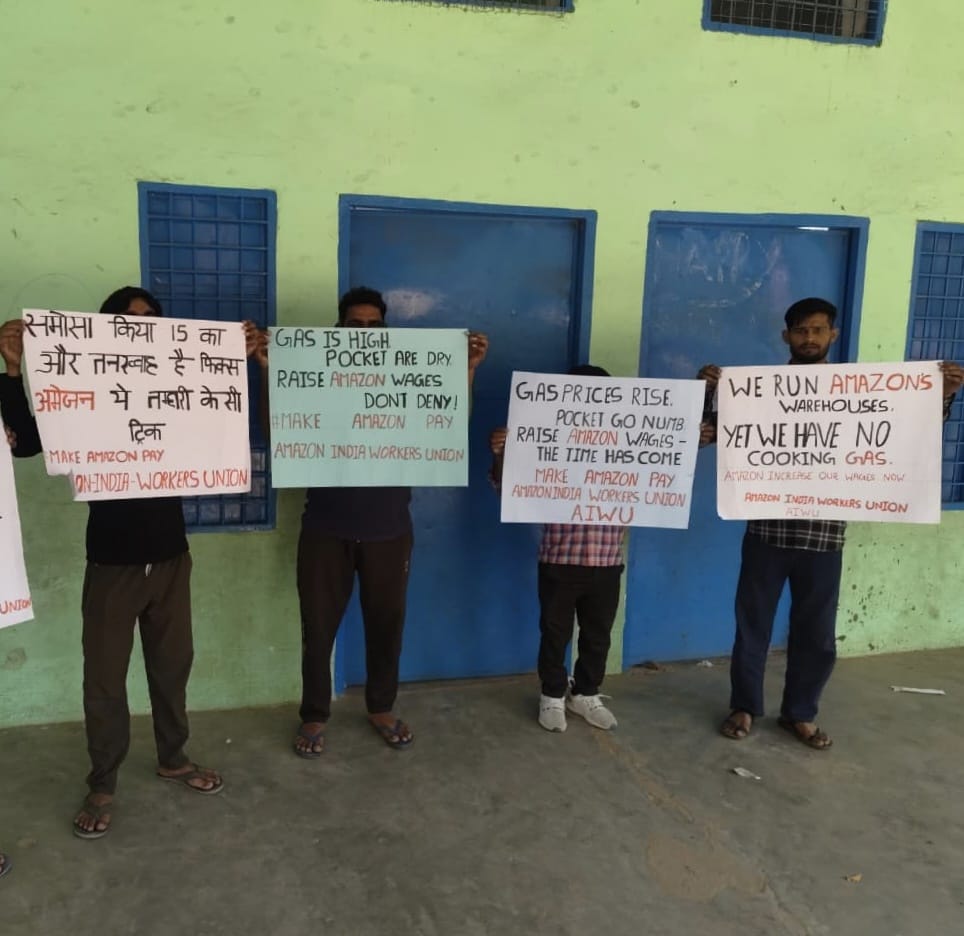
Nitesh: So the organizing has been largely informal but still significant. Not every worker, but particularly in the warehouse clusters, workers have come together through unions and collectives, raising demands for wage increases and highlighting how rising living costs are making survival difficult. For instance, they formally wrote to the companies. The Amazon India Workers Union and the workers have written to the company seeking compensation or a wage revision in response to LPG price hikes. We have also released a press release for that. At the ground level, organizing also looks like small-group discussions in worker housing areas, collective decisions to raise issues, and connecting with organizations or unions already working with them, such as AIWU. So it’s not always large, visible protests; it’s often quite everyday forms of collective assertion shaped by fear of job loss and precarity. And we have also seen changes in wages, as there were protests in Uttar Pradesh and Haryana over wages and working conditions in Noida, Gurgaon, and other states. So these are like a domino effect, because the workers are getting a wage increase of $1 or 50 cents, which isn’t ideal.
The workers show how the owners and the managers can buy big cars, big houses, and we who run these corporations are not able to buy a proper meal, not even once a day. So the point is that this is a domino effect. The larger issue was the wages and the working conditions.
TSS: Are there also attempts to organize more generally against the war?
Nitesh: Direct organizing against the war itself is limited, because – especially among workers – their immediate concern is survival, not geopolitics. What we are seeing instead is organizing around the consequences of the war, such as rising prices, loss of income, and reduced access to essentials. Workers are framing the demands in terms of wages, affordability, and basic needs rather than foreign policy. The situation is still evolving. There is anxiety and uncertainty. If prices remain high or, you know, it politically continues, we may see more visible and coordinated anger and discomfort, but at the moment, responses are fragmented and issue-based, rather than politically directed at the war itself. So again, it’s more regarding wages, income, and access to essentials. Because the worker sees what is hampering them. Obviously, the war affects oil and gas prices, and workers see it from the perspective of the affordability of essentials.
TSS: Is there anything you would like to add for workers living in other countries, who may not be experiencing the exact same effects but are still bearing the cost of war on their shoulders?
Nitesh: I think what we are seeing in India is not an isolated problem. It’s a preview of how the cost of war gets redistributed globally, and it almost always lands on workers, any kind of workers. Countries far from the conflict don’t experience bombs or direct violence, but they experience it through fuel prices, food inflation, and supply chain disruptions. And within these countries, the impact is not equal for everyone. Informal and migrant workers absorb the shock first and most intensely. It’s very common in every country.
If workers move across regions, their access to essentials such as food, fuel, and healthcare should move with them. Otherwise, prices automatically exclude the most mobile and vulnerable workers, as we are seeing with LPG prices in India. Cooking fuel is not just a commodity; it directly affects nutrition, health, and dignity. So countries should have emergency buffers or targeted subsidies that actually reach informal workers, but not just those already inside former systems. The system should be designed for the workers at the bottom of the pyramid, not for those at the top.
And recognizing that supply shocks become a labor crisis every time something happens. Fewer meals, lower remittances, and return migration. And policy responses need to reflect this lived reality, not just macro indicators. We also need to put responsibility on companies, not just states. So in sectors like logistics and platform work, companies benefit from flexible labor, but they externalize risk. During a crisis, there should be mechanisms to adjust wages, relax penalties, and ensure income protection. Otherwise, global shocks are silently transferred onto workers’ bodies, which we are seeing right now. So, in the end, I just want to say that wars are fought between nations, but the economic costs ripple through supply chains and fall on workers. And unless systems are designed to protect them, every global conflict becomes a local survival crisis. So we have to be a little bit conscious of what we are also trying to do for the larger workforce. At the end of any crisis, any burden is borne by the workers. And COVID and the LPG are the biggest examples.