
These ‘Ten Theses’ invite discussion on how we – as militants, workers, feminists, LGBTQI+ people, migrants, trade-unionists, activists for climate justice and for peace – can together struggle in the dark times in which we live.
The theses are the outcome of an open collective process still in the making within the Transnational Social Strike Platform. Their aim is to identify what we think are the political priorities that must be addressed if we don’t want to get stuck in the cogs of war. War is reshaping the political conditions of all our struggles, even beyond the battlefields. There is no class struggle against exploitation and oppression or for social justice that is not directly or indirectly affected by this war regime, by its economic and social effects or by the spreading militaristic ideology. With these theses we want to break the fear that the war imposes on us, and that has for too long prevented us from building a transnational communication on what we have and what we lack.
As TSS we promoted the formation of the Permanent Assembly Against the War (PAAW) immediately after the beginning of Russia’s full-scale invasion of Ukraine. Facing divisions and a sense of disorientation, the PAAW made possible a discussion on the war among activists and militant groups beyond the geopolitical trap, and in July 2022 released a Manifesto for a Transnational Politics of Peace. Many of the issues addressed in the Manifesto remain largely unresolved, but that perspective kept a discussion alive, involving comrades from different countries and backgrounds and bringing us to where we are today. Europe at war marks a new step in a collective effort against the war.
We held our first assembly of Europe at war in Cologne in February 2026, where we acknowledged that the sense of fragmentation and weakness experienced by social movements had to do with the ways in which we’ve (not) been properly talking about the war. Geopolitics and campism have been infiltrating our side, a side which is not the one of any state or alliance of states. Just as militarism has reinforced the fear of an external enemy in order to bind the oppressed to their oppressors, so the same friend-or-foe logic has also been dividing our struggles. We have taken part in large-scale mobilisations, especially against the genocide in Gaza, but not in a full anti-war movement. At the moment, student protests and strikes are sweeping across Europe and beyond. From France and Italy to Spain, from Germany to Albania, thousands of students, teachers, and workers are taking to the streets to reject a future marked by war, rearmament and growing precarity. Instead of giving in to fear, we want to show the connections that may unite us and to trace together the cracks and tensions within Europe at war that make our political intervention possible.
Europe is at war well beyond the Ukrainian battlefield. Europe at war implies the direct involvement in, and support for, military operations and genocide. But it is also the context in which states and capital are reshaping their deadly alliance to maintain exploitation and guarantee valorisation. Europe at war wears many faces that we need to be able to understand and recognize. By this we don’t want to assert a European exceptionalism: Europe is at war because the world is at war. We focus on Europe because it is the space that is closest to us, and because the EU and European countries, albeit crisscrossed by transnational processes that go well beyond their borders, are fully involved in the politics of war. At the same time, we are also aware that today’s EU is part of our problems, not the solution.
Europe at war is our political hypothesis for pushing our struggles towards a transnational organisation that is able to articulate our political differences, overcoming sectorialisation struggles and overturning this dire present. The very possibility of putting an end to any present or future war, with all its atrocities, depends on the strength of our struggles against capitalism, patriarchy, racism and for climate justice. How to build the social power that we lack is the organisational problem that these theses invite us to face and discuss.
Download and share the Ten Theses on Europe at War:
1. Europe is at war
Since the Russian invasion of Ukraine, and then with the genocide in Palestine, we have seen the multiplication and exacerbation of local and global conflicts. War is the dire reality in many places. But war does not stop at the battlefields. The logic of war, with its distinction between friends and enemies, has permeated society as a whole, increasingly shaping economic, social, and political relations. The result is an atmosphere of submission, hate and fear. Traditional forms of soft power and the manufacture of consent are being replaced by methods of brute force, coercion, threats, and blackmail.
Thus, a Europe at war is not merely a Europe defined by rearmament plans and dangers of escalation. This regime of war is nowadays the political environment shaping the limits and possibilities of every struggle for liberation – against exploitation and violence, against capitalism, patriarchy, racism and the climate crisis. Europe at war manifests itself quite obviously in the reintroduction of military conscription, or in weapons production. But it may also have the face of a Ukrainian woman employed in a German factory in Poland, fighting against hardened sexual and racial conditions of production and social reproduction, or that of a head of government announcing new cuts to wages and social welfare in order to meet the demands of increased military spending, that of the criminalisation of social protests, or that of migrants depicted as ‘hybrid weapons’. We need to grasp this new scenario of struggle and adopt a new strategy if we don’t want to be sucked up into the lines of an unbearable war logic.
Europe at war is not isolated from the world. It is rather one of the many faces of the world war currently waged against workers, women and lgbtqi people and migrants. It is a form of reaction: the last resort becoming the first in a desperate attempt by European states and capital to assert control and secure valorisation amid transnational disorder and internal crisis.
We don’t mean to suggest that war is felt throughout Europe in the same way, nor that Member states and the EU share a single, unified plan. Europe at war is made of differences and contradictions we must be able to understand and connect. It is the puzzle that we have to understand if we want to connect across differences and trace together the cracks and tensions where our political intervention becomes possible.
2. Not geopolitics, but the vocal and hidden social struggles will free us
As the current situation in Gaza shows, deals, truces and ceasefires can be just a cover for the continuation of war by other means. We don’t limit ourselves to demanding a peace made by states that perpetuates the very causes of war. We demand the immediate end of the bombings and the atrocities, but we also know that this is not enough to prevent further atrocities from happening.
We acknowledge that the legacy of colonialism still reproduces global asymmetries of power. At the same time, in the name of ‘anti-imperialism’, the deeds of governments such as Iran’s have been excused because they are seen as potential allies in the fight against the West. We refuse campism – the logic by which the enemy of my enemy is my friend – as we refuse geopolitics, which treats politics as merely a matter of relations among competing states. We refuse a monolithic understanding of “the West”, all the while we recognise that the colonial legacy is a constitutive element of Europe itself, shaping racism and exploitation. It is there whenever a migrant is killed by the police; in the immigration offices, in the factories, warehouses and fields where migrant workers are paid less and made more precarious; in the houses where migrant women clean and take care of the elderly.
Campism is for us the opposite of class politics, which is a transformative and revolutionary politics. No state or alliance of states will free us from the war and its effects, only the power of the multiplicity of struggles by workers, migrants, women and queer people will. We live in a transnational scenario where no state can fully control the social conditions of capital valorisation, nor the transnational movements of people.
The possibility of winning against the war and its world lies in transforming the fragmentation of the living and working conditions into a form of collective power.
3. Opposition to the war is a fight against oppression and exploitation
War is the new context in which we need to organize, even when it does not appear in military uniform. It has material effects on working, living and environmental conditions, and on the reorganisation of production and reproduction. This means that our task cannot simply be to attack arms production, military exercises or rearmament plans. We need to tackle the wider societal dynamics that make war all that we can expect from the future.
Militarist ideology reshapes not only the relation between states and citizens through increased police repression. It also strengthens authoritarian command inside workplaces, houses, schools, hospitals and reception centres. Beyond coercion, this regime uses fear as a tool of power to try to generate support. Constructing an external enemy is aimed at binding people to their ‘domestic’ oppressors and legitimises sacrifice. Thus, reintroduction of conscription is presented as the inevitable consequence of a future Russian attack; or longer working hours are the only viable solution in front of Chinese competition. Despite its evident effects, this militaristic ideology is failing to enroll the whole society, while silent or open forms of insubordination are taking place.
The rise of the far right must also be understood and fought within these wider conditions, rather than as a simple return of fascism. We need to turn our anti-fascism into a movement capable of striking at the very social and political conditions that reproduce war and let the far right grow. We have to face the contradictions and different temporalities across Europe, which means being able to read forms of opposition to the war and its effects even when the war itself is not explicitly mentioned.
Solidarity with existing struggles is important but is not enough. We have to become able to anticipate where possible moments of refusal might emerge. This is the challenge of a transnational organisation daring to articulate different struggles and transform them into new ones.
4. A neoliberal military conscription is in the making
From France to Belgium, from Romania to Poland, military conscription is making a comeback. War demands sacrifice, taking a human toll to remind us of the necessary obedience to the constituted authority. Yet, the new forms of military conscription no longer rely only on patriotism, civic duty and compulsory draft, but also on economic incentives, status privileges and a voluntary basis. In front of a dismantled welfare state and worsening economic conditions, armies now offer young people education, wages, easier access to public-sector jobs, “life competences and skills” for improving their careers.
Conscription plans are therefore intertwined with the European wage regime. After years of lower salaries, dismantled welfare, and poorer education, military conscription appears as both the phantom of the nation state and the reminder of the necessary sacrifice of those living on their wages.
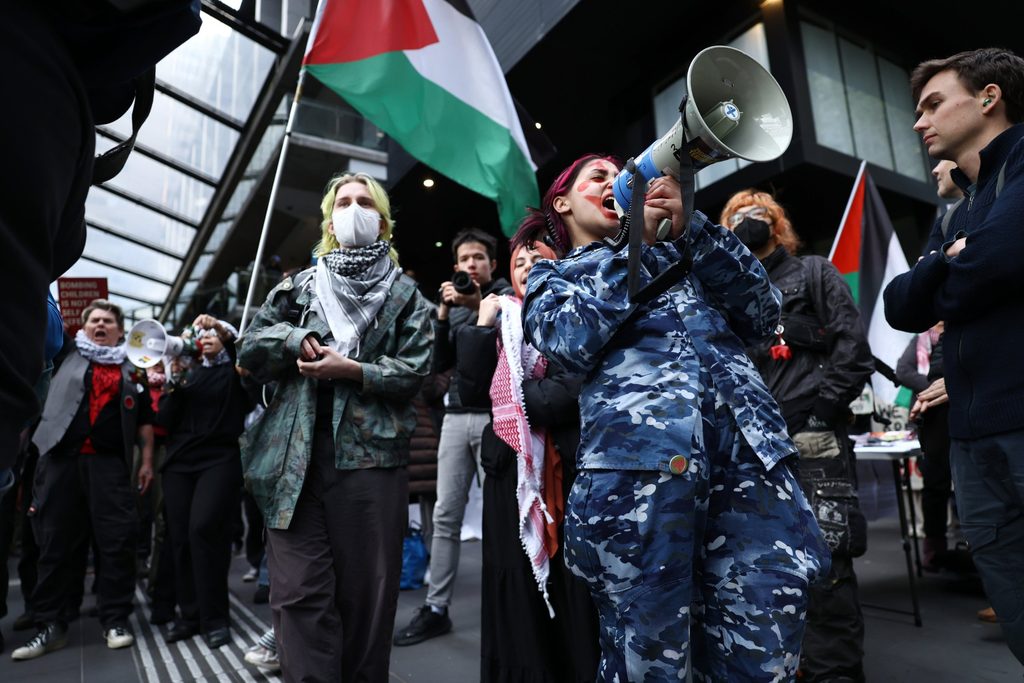
However, signs of refusal of a future made of weapons and poverty are sprouting. This year German students have gone on strike three times against military service and against a future made of war. In fact, although the German government is determined to build up the largest army in Europe, it still has great problems to ensure this by recruiting young people. The result after 300,000 letters to young people: 530 conscripts. Waves of student protests and strikes are mounting across Europe, in France, Italy and Albania, demanding better education and a future without the misery of war.
To make these forms of refusal bigger and stronger, we cannot take a moralistic approach. Recognising that, in the dark times ahead, the ability to refuse war may itself be a privilege does not mean surrendering to the harsh reality of coercion and blackmail. To be effective, the refusal of conscription must be coupled with a refusal of the capitalist, patriarchal, and racist conditions that increasingly make military service appear like a viable option.
5. The war paves the way for a new European wage regime
Over the past two years, European countries have passed measures that have laid the ground for a new European wage regime. Many laws and reforms have been discussed to increase the working time: extending the working week, postponing the retirement age, or making overtime more convenient through tax breaks. While people are being asked to work more – for wages that cannot keep pace with inflation – at the same time governments are cutting social welfare, therefore curtailing the indirect wage. The right to strike and unionise is also under unprecedented attack.
This new European wage regime is not only related to specific working conditions, but bends people’s lives to the needs of employers and capital according to sex and migration status. It increases the burden of production and social reproduction on women – by attacking their possibilities to build a life outside of the family and legitimising patriarchal authority – and it is linked to the migration regime, since the residence permit tightens the grip on migrant labour.
Within the new European wage regime, war is used as a justification, as the overriding necessity making these attacks on workers appear inevitable. If “readiness” must be secured, it is first and foremost the readiness of workers to be exploited, overworked, and obedient. No such obedience is asked from capitalists and investors for the sake of the nation. Militarism prescribes social peace in the workplaces and the silencing of all the political differences.
Throughout Europe, the new wage regime is how the war scenario is contributing to reorganise exploitation and oppression amid the transnational disorder. Opposing Europe at war also means fighting against the European wage regime, and making visible all the struggles against capital valorisation taking place inside and outside the workplaces.
6. Institutional racism is a weapon of the war
European governments are using migrants as scapegoats to justify social cuts and spreading militarism, while increasing their daily exploitation. In countries such as France, Italy and the UK, governments are targeting migrant communities with racist and islamophobic laws, for example by banning the veil in schools. This increasing internal racism goes hand in hand with stricter migration policies, making living and working conditions for migrants harder and harder.
The new Pact on Migration and Asylum pushed institutional racism to a new level. It has dismantled the asylum system as we knew it, reinforcing the depiction of migrants as ‘enemies’, or as ‘others’, that threaten the alleged integrity of the nation. Despite its name, the Pact has very little to do with the right to asylum. It attempts to regulate movements of migrants, creating the conditions for the government of their labour based on institutional racism and exploitation. The Pact, which was welcomed by the European Parliament as the beginning of the ‘era of deportations’, expands the logic of border externalisation by creating return hubs in third countries. Following the ‘Albanian model’, migrants whose asylum claims have been rejected may be transferred, detained or expelled. The racialized targeting of migrants thus becomes a point of convergence between neoliberal governance and the far right, both of which draw on exclusion, precarity, and the production of internal enemies to sustain existing relations of power.
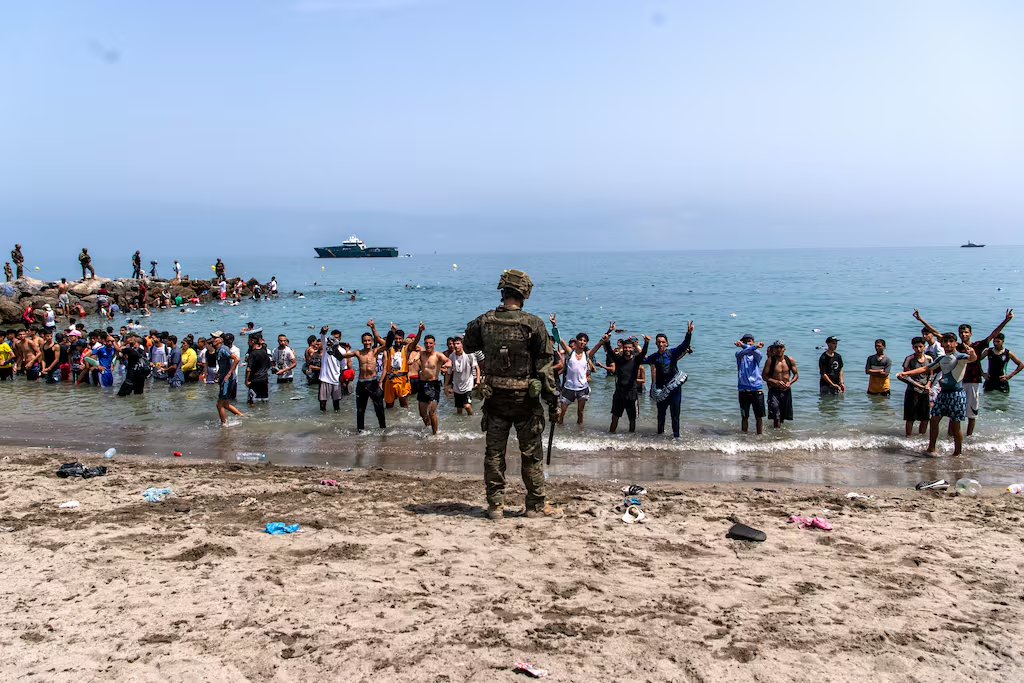
However, migrant movements, inside and across the borders, defy the militaristic dreams of internal and external control of the workforce. These are transnational movements – such as the one we witnessed in Ceuta last summer – that show autonomy and strength, and we need to support them. Through their mobility, solidarity, and struggles, migrants challenge the borders that divide us, practicing a politics of peace. Against a political order that depends on the production of enemies and the normalisation of exclusion, these movements open up possibilities for other forms of collective struggles against the war.
7. European rearmament is a process of capitalist restructuring
War is reorganising the infrastructures through which capital, commodities and labour circulate, and the political significance of these developments goes beyond defence policy.
The White Paper for European Defence and the ReArm Europe / Readiness 2030 plan are mobilising billions of euros and redefining what counts as productive investment in Europe. Military investments are now widely regarded as an engine for growth, competitiveness and technological innovation. In Germany, the militarisation of the economy is presented as a cushion to the collapse of the automotive industry. ‘Readiness 2030’ aims to raise €800 billion in investments through a combination of expansionary fiscal policy and the mobilisation of public and private capital. This is not simply about producing weapons. Ports, railways, roads, logistics hubs, energy systems and industrial facilities are increasingly conceived as dual-use infrastructures, simultaneously serving civilian and military scopes.
The same European institutions that otherwise insist on budgetary discipline are now creating unprecedented fiscal flexibility. Security infrastructures increasingly receive political priority, while the infrastructures of social reproduction – such as housing, healthcare, education – remain subordinated to fiscal constraints. Rather than asking only how Europe is preparing for war, we should understand how war is becoming a principle for reorganising production and reproduction, territories and public investments.
These new investments and new rules are presented as ways to secure Europe’s political and economic position on the global stage and to safeguard trade routes, markets, raw materials and technologies. However, militarisation and rearmament are rather a symptom of a crisis of capitalism that increasingly resorts to violence in trying to deal with its own contradictions. In fact, due to their limited productive impact, these investments will not solve neoliberalism’s crisis of accumulation nor give back control to states. Whether we will be able to turn this crisis to our advantage will depend on our ability to organise at a transnational level.
8. The war is blocking our capacity to struggle for climate and social justice
War destroys the planet, while militarism stifles our capacity to build a transnational climate politics against it: the violence of weapons displaces the urgency of addressing the climate crisis. Even though it has never been this urgent, the phase-out of fossil fuels has never been so far down the political agenda. In fact, militarism deepens the dependence on fossil fuels while making them unaffordable for millions of people. The climate movement is struggling to find the transnational strength needed to oppose the increasing exploitation of both the so-called ‘strategic’ resources and the labour of millions of people.
The EU Green Deal was never meant to answer our demands for social and climate justice: it was a mix of energy expansion, through partial conversion, and relocation of key productive sectors, such as the automotive, to enable the continued accumulation of capital. Today, the rise of the right and new geopolitical imperatives are erasing the climate issue as a priority. In February 2025, the EU launched “The Clean Industrial Deal”, a new phase of the Green Transition that aims at maintaining European control over industrial and energy policies. This Deal seeks to legitimize EU investments in military production. It is both a strategy to alleviate the crisis affecting productive sectors like the automotive industry, and a general attempt to align the interests of the digital and clean-tech industries with those of a Europe at war. In order to assure its tech sovereignty, the EU has declared it will triple its data centre’s capacity in five to seven years. To circumvent the problem of the huge cost of these infrastructures – in terms of energy, pollution, water and land – member states have been asked to design special ‘acceleration zones’, to help streamline the projects’ environmental impact assessments.
These obstacles to climate action are inseparable from worsening working conditions in ‘green’ and other factories, the criminalisation of dissent, the threat of worker dismissal, rising living costs and environmental devastation. Those affected by pollution and exploitation must now find ways to overcome the barriers that restrict transnational organisation and mobilisation, and develop the strength to resist the authoritarianism and militarism imposed by a warring Europe.
9. The war strengthens the patriarchal, racist and authoritarian conditions of social production and reproduction
The neoliberal state has given up its role of mediating between capital and labour. Social peace is no longer guaranteed through universal welfare but through individualised compensation, competition among different segments of society, and nationalistic and exclusionary politics.
Within Europe at war, women, and especially migrant women, are asked to carry the weight of reproductive labour, and to do that for the sake of the nation. Militarism reinforces patriarchal authority, even when women are enrolled in the army. Attacks on women’s freedom, the increase in femicides and male violence have to be understood in direct connection with the impoverished material conditions and with economic incentives designed to ‘reward’ family-centred life choices. Political rhetoric increasingly links war and reproduction, as in France with Macron calling for a ‘demographic rearmament’, folding natality into the language of national preparedness and sacrifice. Ukrainian women are enlisted into the national interest for working hard in production and reproduction, but they are depicted as enemies when they fight against the forced conscription of men. National interest mobilized by war hides the fractures that crisscross society, and the coercion necessary for its government.
Education is also affected by the war, shaped to reproduce a hierarchical society built on violence, competition and poverty. School programs are changed to promote love for the nation and soldiers are invited to teach classes. Universities and research, financed under the banner of dual use, are oriented by competition and towards the needs of capital.
None of these policies began with war, but war gives them a new meaning. Patriarchy and racism, authoritarianism and militarism, climate catastrophe, are all woven into the same dark fabric. Therefore, struggling on the terrain of social reproduction cannot simply mean demanding a fairer distribution of social spending – it means unravelling this dark fabric altogether.
10. Strike against the war! The challenge of a transnational organisation
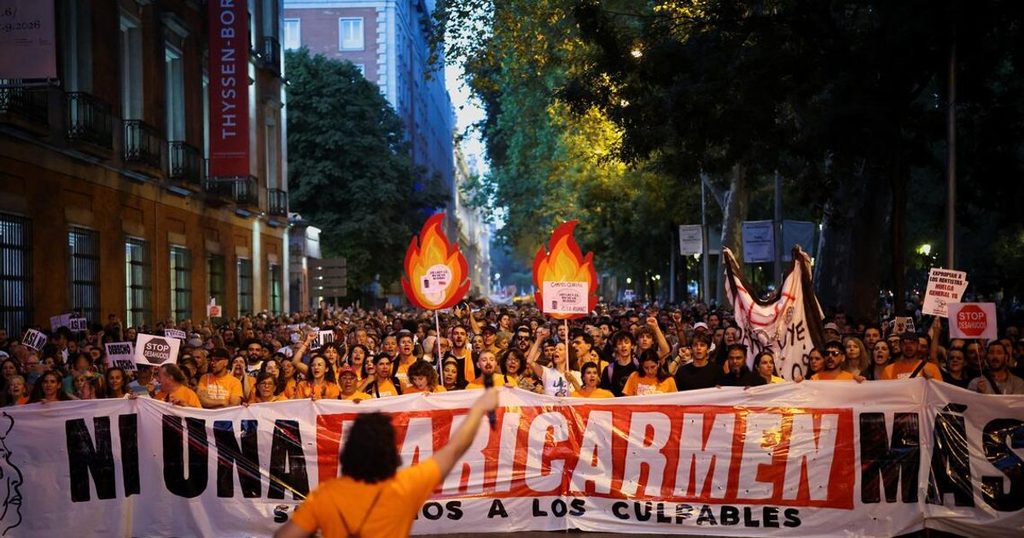
A strike against the war was unthinkable until recently, but things are changing. The strikes in Italy and Spain against the genocide in Gaza, the student strikes in Germany, France and Albania, the organising of Ukrainian workers in Poland, the protests in Greece against labour and pension reforms: they all show that things are moving, and moments of collective refusal of the war are sparking. Taking seriously Europe at war means to openly discuss how to build wider alliances to give more power to the fragmented opposition to our dire present.
War cannot be a preoccupation of anti-militarists or pacifists alone. It is a problem for everyone who is opposing exploitation, oppression, racism and authoritarianism. War forces us to radically innovate our practices. There can be no single target – whether a summit, a weapon factory or a symbolic site – capable of summing up all that we hate about Europe at war. We need to be transnational in our aspiration and imagination. We need to be able to see, across borders, every single moment where a ‘no to war’ is spoken or lived by, where the possibility of things going otherwise than the certainty of death and violence can be glimpsed. We all need to resist the logic of war, to not lose hope in the face of adversity, and remind each other that, however harsh the conditions of our struggles may become, we are many – and we have a world to win!
Our map of Europe at war will not be drawn according to geopolitics, but according to the vocal and hidden resistances and struggles of those who are paying the highest price for the war. Right now the transnational disorder of war appears in the shape of violence, death, borders, economic crisis. Yet what is at stake is the possibility to turn the cracks and signs of refusal into a transnational politics of peace: a European strike against the war for the sake of a project of liberation that turns the very causes of war into a field of common struggle and organizing.