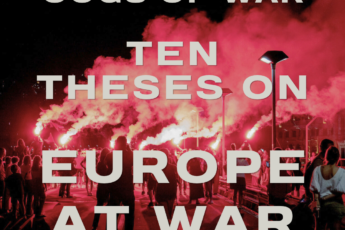

After we published our invitation to the meeting Europe at war, the world war scenario has materialized even more clearly.
At the beginning of this year, Trump attacked Venezuela and kidnapped its president, Nicolas Maduro, and his wife. He did so disregarding international law, showing that arbitrary military intervention and violence can be used anytime to protect US profits and strategic interests. Since he took office, Trump has bombed Iran, Iraq, Syria, Somalia, Yemen, and Nigeria, asserting that the only limit on his global powers is ‘his own morality’. In the transnational chaos that characterizes the current world war scenario, military operations can be carried out at any time in order to impose increasingly precarious conditions for capital valorization. The announcements of possible military operations in Greenland, Cuba, Colombia or Iran are as dangerous threats as insane attempts to regulate through violence the ongoing instability. Militarism is used not only to drive foreign policy. In the US, the same militaristic ideology, which preaches violence for the sake of national glory and unity, is employed domestically to justify the indiscriminate abuses of ICE officers against migrants, workers organizations and anyone who tries to oppose the government.
Militarism is on the rise worldwide, making war the new normality. While most of the Western media are covering Trump’s attacks and military threats, other war scenarios risk getting out of sight. The truce in Gaza hasn’t brought an end to the genocidal war and the colonial occupation of the Palestinian territories. As the talks on ‘phase 2’ of the Gaza plan slowly proceed, with the creation of a technocratic ‘Board of Peace’, it is clear that the plan for reconstruction will have as its only priority the interests of transnational capital in the region, rather than the lives and freedom of millions of Palestinians.
While a mass movement against the Islamic Republic is storming Iran with thousands of people killed, the Islamist government in Damascus – having obtained recognition from Trump and the approval and military support of Erdogan and Netanyahu – has announced its intention to invade the Autonomous Democratic Administration of northern and eastern Syria, with the aim of putting an end to the confederal revolution of the peoples of Rojava. In Ukraine, as we are approaching the fourth year of war, bombings keep on killing thousands of soldiers and civilians, as 2025 was the year with the highest number of casualties since the beginning of Russian aggression. On February 5, 2026 the nuclear arms agreement between the United States and Russia ‘New START’ will come to an end, without any prevision of a further extension. That will mean that there will no longer be a cap on nuclear warheads, potentially escalating a new nuclear arms race.
In light of the latest developments in the world scenario, European governments are not only doing nothing to prevent further escalation of the war but are instead seizing the opportunity to advance their rearmament plans and militarist propaganda. After Trump’s declarations on Greenland, several European states are now sending troops to the region because, as declared by the German chancellor, Friedrich Merz, Greenland’s security against Russia and China is a concern for all the NATO countries. In fact, the so-called liberal democratic powers have been very reluctant in denouncing the US’s crimes, especially since, as put by the Polish President Karol Nawrocki, only Trump can stop Putin from threatening the Eastern European states. Moreover, this week, the European Commission formally presented a 90 billion loan package to Ukraine. Two-thirds of this loan will be used to provide military assistance, with the condition of giving preference first to European armament industries, as such, showing the capitalist interest in continuing the endless war in Ukraine.
In this context, geopolitical tensions legitimize pharaonic and unsustainable infrastructures such as the Black Sea “Neptune Deep” platform, as well as the further implementation of militarization in economies already weakened by austerity policies. Under these conditions, the far right is not only the only political force that is articulating, demagogically, a discourse on peace, but is also able to capitalize on the limits and failures of European integration. Their rhetorical aim is not so much to become Russia as to become “like” Russia: the exaltation of a particular form of authoritarian, masculine, and Christian governance, posed in opposition to what they depict as a feminized and corrupt West. In this sense, the current crisis merely exacerbates the internal contradiction of the EU model, which is founded on the management of the Eastern bloc as an exploitable semi-periphery. The energy infrastructure has increasingly become a political and military weapon (as is currently deployed by Russia in Ukraine) framed through narratives of security, sovereignty, and independence that conceal new forms of extraction and dependency. At the same time, borders—both at the edges of Europe and within it—are reinforced through migration and asylum regimes that produce racialized distinctions, and secondly that enforce the role of Eastern-Europe as a “buffer-zone” of “the real Europe”. Fear, carefully cultivated through images of invasion, instability, and permanent crisis, becomes a key resource for nationalist and far-right imaginaries, enabling authoritarian measures while redirecting social anxiety away from structural inequality and toward constructed internal and external enemies.
Considering these events, we can also observe that for many around us, history is already written. We see that those close to us increasingly succumb to the logic of war, perceiving it as an unstoppable automatism. It is deemed necessary to further enhance the war readiness of national armies and to deploy them across the globe in the hope of preventing war through deterrence and defense capability. However, the opposite is true. The constant escalation and warlike behavior make the question of war appear inevitable. It’s no longer about whether it will happen, but only when. This perception of geostrategic logic is taking hold in our minds – resisting it is seen as the task of the left in this time.
As the world is more and more fragmented, and divisions along nationalistic lines are deepened, it is our task to avoid the deadlocks of campism, connecting the different movements of resistance and opposition to the war and its effects. We need to give visibility to the different struggles that in different moments, defy the current state of affairs; otherwise, they risk disappearing under the fog of the war. The constant challenge to break the fronts also means that, in order to oppose Trump, we do not necessarily have to side with Maduro and repropose an old-style anti-imperialism. This means also that to side against Israel’s genocidal project, we do not need to be in any way milder against the religious government of the Islamic Republic as an enemy of the Western front. We side with all of those who are right now opposing Trump’s imperialist manoeuvres and, at the same time, fighting for better living and working conditions and against authoritarian and patriarchal regimes. These days, the struggles of the Iranian workers and women, who had already taken to the streets with the ‘Women, Life, Freedom’ movement in 2022, are showing the class and anti-patriarchal dimension of their fight against both the Ayatollah’s brutal regime and against Western sanctions and the threat of a military attack by the US. Sanctions have been a weapon against the Iranian working class and benefit the right-wing side of the opposition to the Islamic Republic, as does the threat of an American military attack.
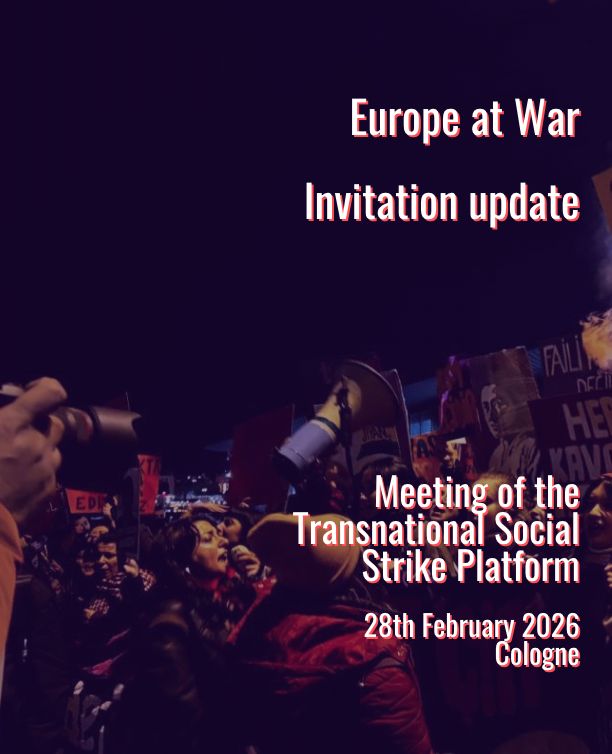
We’ve been saying that our opposition to the Third World War has the ambition to choose our side, without surrendering to the deadly alternatives that are presented to us. We choose to side with workers, migrants, students, women, and LGBTQ+ people who are everywhere fighting against militarism, exploitation, racism, and patriarchal violence. To find tools and words to break the fronts together and to foster our transnational communication to bridge the divisions and distances that still divide us, we invite everyone in Cologne on February 28 to our meeting, Europe at War: militarism, rearmament and transnational organizing.