
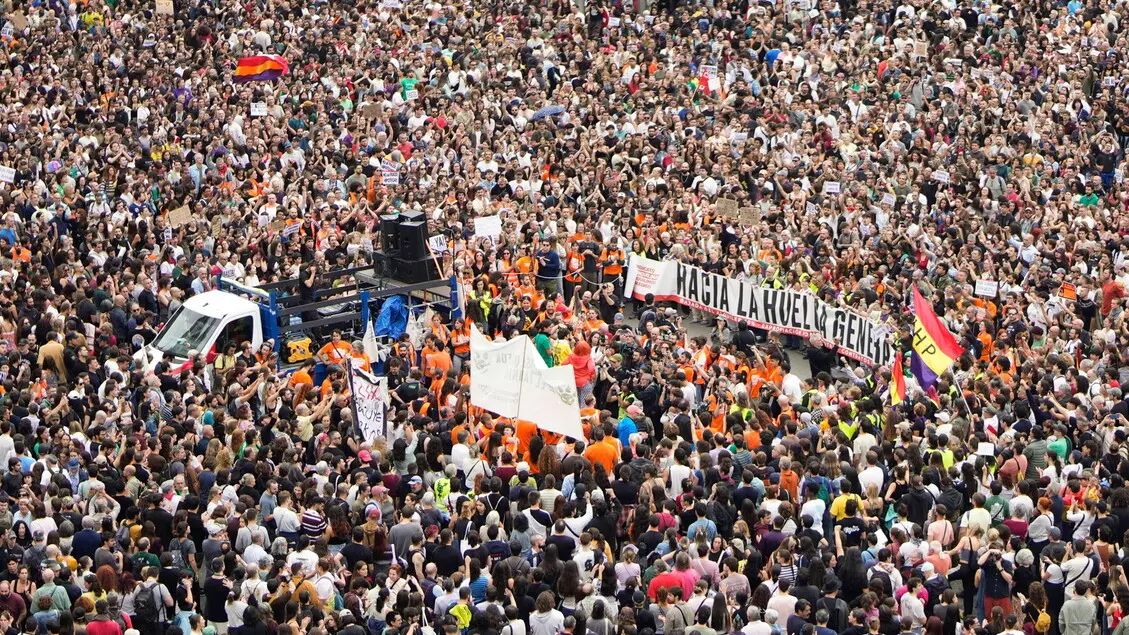
On the occasion of today’s general strike in Spain, on 11 November, called in the wake of last October’s great wave of mass mobilisations for the right to housing, we publish a multi-voice interview with Edu Lozano, communications secretary of CGT Catalunya; the International Commission of the Tenants’ Union (CSI); and L. Cervantes, a postal worker and CGT member. The interview closely follows the organisational work that led up to the strike, and it brings out the contradictory role of the unions. While the grassroots unions and the Tenants’ Union were already mobilising, the confederal unions had to chase the mobilisations, bringing forward the call for a general strike that had already been planned. Calling the strike during a power vacuum raised some doubts, but it also allowed even the unions least willing to protest against the government to join, producing a broad alliance that opens spaces for radical subjects and voices as well. The interview also shows the importance of the connection with the feminist movement, which in recent years has placed social reproduction and the care work performed by women and migrants at the centre of political discourse – the coming 25 November will be a further test of this connection. The position of students is significant: in Spain, as across Europe, they are rising to refuse a future of war and precarity, and in the Spanish context they are mobilising for the right to housing as the symbol of a struggle against exploitation and wage impoverishment. The connection with schools is strengthened by the strike of early childhood educators, who have been in agitation since the start of the school year and are striking for higher wages and against the invisibilisation of their essential work. What remains an open question is how the Spanish events can feed a European and global movement against neoliberalism, one that asks for neither compensation nor relief.
1. Who are the main social and political subjects driving the mobilisations in Spain? What is the role of the unions, the housing movements, student organisations and feminist collectives? Are there forms of coordination among the different groups and among the mobilisations in different cities?
[Lozano] First of all, the housing movement, which includes several unions, such as the Sindicato de Inquilinas, the Sindicat Socialista d’Habitatge and COSAHC in Catalonia, or the PAH [Platform of People Affected by Mortgages]. On the other side, there are the classic labour unions to the left of CCOO and UGT, namely CGT, CNT, COBAS, Solidaridad Obrera and the pro-independence unions (ELA, LAB, COS, CIGA…). In Catalonia, for example, labour unions and housing unions jointly promoted the campaign «Ens costa la vida» («It costs us our lives»), and on 6 June a large consultation was held to ask citizens whether they would be willing to strike over the current housing situation. The student movement is taking an active part in the acampadas (encampments) that have sprung up across the peninsula.
[CSI] The housing movement is one of the engines of this cycle of mobilisation, together with sectors of trade unionism, the student movement, feminism and other social struggles. The 11N general strike comes from the need to connect struggles that have often remained separate. The challenge is to build a common response starting from workplaces, schools and neighbourhoods. We do not want isolated struggles against problems that share the same root. We want to build a collective force capable of confronting them.
[Cervantes] The mobilisations are multifaceted. Informal networks that suddenly reactivate, highly structured organisations that follow these events from a distance, calls that «fail» or get very little response, and others where the media act as a powerful amplifier: these situations follow one another constantly.
It is true that the Socialist Party in the central government, which recently decided to bring the general elections for Parliament and the Cortes forward to 29 November, will benefit from the current unrest. It is also true that unrest always occurs in the context of elections, and that many European countries go through this process at similar moments, so that processes of unrest end up happening simultaneously. On the other hand, it is striking how CCOO and UGT, union organisations rather distant from workers and from the rest of the militant unions, always find a way to reposition themselves, to take the lead in the mobilisation and, eventually, to contain and dissolve it. Indeed, looking a little more closely, in this case we could say that the so-called “militant” union organisations have proved to operate within extremely limiting or even exclusionary structures. This is perhaps how the need was felt to create a union specifically for housing. But in the case of the general strike for the right to housing, as in that of education, there are many actors whose interests differ from those of the State, of the political faction of the bourgeoisie in power – in this case PSOE and Sumar – or of the parliamentary left, such as Frente Amplio, which has just made its debut in these elections; Podemos, Izquierda Unida, the Communist Party of Spain, etc.
Organisations such as the Sindicato de Inquilinas were able to seize the favourable moment and ally with the major unions, as well as with the others that joined the movement. From CGT, with a clear affinity and closeness, to other unions such as CNT, with more critical attitudes, which raised the issue we mentioned of this movement being used for electoral purposes.
The more autonomous social movements also joined with criticisms, which were echoed in the media more generally. The feminist movement, too, launched initiatives in support of the movement as a whole, such as the one on 25 November against violence against women.
2. How do demands for the right to housing intertwine with those concerning wages, precarity and working conditions? Does this link translate into common platforms of demands and concrete practices of mobilisation?
[CSI] Today, having a job no longer guarantees a dignified life. Wages go up, but rents, energy and food eat up our incomes. That is why the struggle for housing is also a labour struggle. What is the point of winning a wage rise if it goes straight into the landlord’s pocket? We don’t want to work to pay rent.
[Cervantes] Formally, an agreement has been reached among the main unions at different levels: within the strike committees of the education sector, an assembly has been set up, made up of the various subjects mentioned earlier, such as “Menos Lectivas”. However, they need to be very careful, because it already happened with the earlier «Marea Verde», which stopped behaving as an independent, or relatively independent, organisation of workers. In the local assemblies being held in neighbourhoods in preparation for 11 November, there are representatives of the major unions and a younger, more movement-oriented militancy, and they clash when it comes to defining common platforms of demands. The movement for the right to housing already has some history behind it. We can trace it back to the creation, as far back as 2008, of the Platform of People Affected by Mortgages (PAH), an organisation born after the 2007-2008 crisis, first in Barcelona and then extended to the rest of the country. Later, in response to the second wave of crisis, the Tenants’ Union took shape in 2017.
3. The slogan «Poner la vida en el centro» [Putting life at the centre]: how is it being rearticulated today in the mobilisations for housing and wages? What role are feminist organisations playing?
[Lozano] Within CGT, the comrades are bringing in this discourse and the practices they experimented with in the recent feminist general strikes of 8 March, centred on care.
[CSI] It means that the economy must serve life, not life serve the economy. For decades, feminism has denounced how the system makes care and reproductive labour invisible while prioritising private profit. Today, unaffordable housing, insufficient wages, or the lack of public services are different expressions of the same contradiction. Putting life at the centre means that our homes, our bodies and our time are worth more than their profits.
[Cervantes] The slogan “Putting life at the centre” seems to connect to a critique of commodification. A government formed by the current opposition would be a serious threat to women’s rights. There is talk of a return to the criminalisation of abortion, while PSOE proposes to enshrine the right to abortion in the Constitution. Likewise, the education sector is quite feminised and, finally, feminists on the ground are relatively well organised, so that, in general, a level of dialogue is maintained, since they are a strong mobilising force, as they show every year both on 8 March and on 25 November.
4. Students are also taking part in the mobilisations, especially in Madrid, where protests in schools and universities are intertwining with demands for the right to housing. What role is the student movement playing? How are relations developing among students, teachers, workers’ unions and housing movements? Are schools and universities turning into spaces for the autonomous organisation of the mobilisation and the general strike?
[Lozano] Last school year there were strong mobilisations of education workers in Catalonia, the Valencian Community and Aragon. This year they are continuing, and Madrid has joined. This movement, which goes beyond teachers’ labour demands, has pushed many young people to defend education and housing as members of the working class.
The university has always been a place of politicisation and struggle for young people. It is no coincidence that today, given the generational problem they are experiencing because they cannot become independent, the university has become a place of debate and organisation.
[CSI] The housing crisis hits students, teachers, families and workers. We cannot defend quality public education if those who sustain it cannot afford to live near where they work or study, if children have to change schools constantly or have no safe space at home to do homework or study. We need assemblies, committees and organising spaces that connect schools with neighbourhoods and workplaces. The strike is not built only in factories and offices: it is also built in classrooms and neighbourhoods.
[Cervantes] Last academic year was marked by an exhausting programme of mobilisations, strikes, demonstrations, the creation of strike funds, various events… by the tireless early childhood (0-3) educators. The protests in universities, and also the harsh repression suffered in the case of the «Somosaguas 7» – an anti-fascist demonstration called at the university that ended with hate-crime charges against the anti-fascist protesters – have carried over into the start of the current school year. Right at the start of the 2026/27 school year, the educators of children aged 0 to 3 came back with an indefinite strike. They called the strike from 6 September and, through PLEI (Labour Platform of Early Childhood Schools), they set out their main demands: «Decent wages, a lower teacher-pupil ratio and the introduction of the educational pair [two teachers present together]». The mobilisations are made possible by unions such as CCOO, UGT, STEM, CGT, CNT and Solidaridad Obrera. With their pale yellow colour, they are filling the demonstrations and setting a frenetic calendar of mobilisations. It is a predominantly female group, with many references to class feminist struggle and a discourse on the «invisibility» they suffer despite being essential workers.
Right now, a great many places are acting as organising hubs: from universities to small neighbourhood organisations and neighbourhood associations (bodies that do not usually take part in general strikes), they are now becoming organising centres for the strike and for all the events taking place in the days before and after. The assemblies, the organisation of blocs during the demonstration, the pickets to counter the coercive power of companies over workers…
5. How did the general strike come to be called? What role did social movements play, and what role did the unions, in particular CCOO and CGT? Will the strike also involve schools, universities and neighbourhoods, as well as workplaces?
[Lozano] CCOO and UGT had no choice but to join the organising that we grassroots unions had been preparing for more than a year. It is true that the eviction of Maricarmen, or the two suicides of Olga and Javier, residents of L’Hospitalet, linked to arrears, generated a movement that spilled into the squares and sped up the call for the strike, which had been planned for 2027. The government’s calling of general elections raised doubts among the population, because it seems the strike is not directed against any government. This made it easier for CCOO and UGT to join, because it would have been rather unlikely for these two unions to strike against the PSOE. It will be a strike in every workplace and every school. It also includes labour demands, such as the 35-hour week, a minimum wage and minimum pension of €1,600, and automatic indexation of wages to the rise in the CPI (Consumer Price Index).
[CSI] The 11N strike is the result of years of struggle against evictions, abusive rents and speculation. The housing movement has argued that denouncing the problem is not enough: tools of collective pressure are needed. The strike must go beyond stopping work. It must also mobilise neighbourhoods, schools and spaces of consumption. A general strike is not just about stopping work, but about challenging who holds power over our lives.
[Cervantes] The initiative came from the Tenants’ Union, which sought an alliance with these unions at the right moment. There was even an attempt to ally with other majority unions in Portugal, such as the CGTP, which, ignoring its own membership and the workers in Portugal, decided not to call any strike coordinated with the unions in the rest of the peninsula. During the open-air assemblies, contacts were established with the comrades encamped in Portugal. There is a path travelled together, a parallel path, which could have converged into a joint general strike. Likewise, this convergence could also be achieved with Italy, building ever closer ties in the wake of these movements. The strike currently involves every sphere of everyday life, and the demands sometimes change slightly depending on who synthesises them, but they all share a common root and spirit.
6. What role do issues of war, Palestine, European rearmament and growing militarisation play in the current mobilisations? Are there concrete links among anti-war movements, student mobilisations and struggles over housing and wages? In particular, is the nexus between rising military spending, the funding of public services and the worsening of material living conditions being addressed?
[CSI] While they tell us there is no money for housing, healthcare or education, Europe increases military spending. It is a matter of political priorities. Solidarity with Palestine and opposition to rearmament connect to the same question: what resources do we devote to sustaining life and what resources to sustaining war? They tell us there is no money for our rights, but for weapons there is always money. We do not accept these priorities.
[Cervantes] It is rather sad not to be able to put the issues related to war on the table, including the events in Ceuta, which, in a sense, are also part of the imperialist tensions between countries. Around 200 people lost their lives and, of the 80,000 who crossed the border, many have suffered hunger, torture, mistreatment, persecution, etc. To our Moroccan, sub-Saharan, and other sisters, who were pushed towards the border in desperation and with no regard for their lives, we did not show the solidarity we would have wished. From the rest of the peninsula and from within Ceuta, there were many acts of solidarity, but perhaps not enough. The issue is still being followed right now, but it has slipped into the background when perhaps it should be omnipresent, just like the rejection of war.
7. What is the relationship between the mobilisations and the Sánchez government? Do the demands express a political programme of their own, an autonomous one, or does a logic of support for the government also prevail in the face of a possible advance of the right and far right? How is this contradiction dealt with within the movements and unions?
[Lozano] The turn of events has raised doubts, but it was considered the best moment in years to call the strike. Whether the PSOE confirms its electoral victory or the right wins, this strike must serve as a warning to those in charge: the working class will not sit on its hands in the face of the housing problem. We think that, if the right wins at the polls, it is important that it finds us organised, because difficult times will come socially and we need to be ready.
[CSI] Our position is clear: no government can replace the organised force of society. We cannot give up our demands for fear of the right advancing. The best way to fight the far right is not to demobilise people, but to win material rights that transform their lives. We don’t want to choose who manages our precarity. We want to put an end to it.
[Cervantes] Sometimes it is like an elephant in the room: different rhythms coexist and respect each other – people more critical of the political framing and others more conformist. Within the public assemblies, the work is at times somewhat hampered, sabotaged and limited by the acronyms of old political organisations, such as Izquierda Unida, whose own city councils order evictions; that is why it can only seem contradictory when they impose their flags during the demonstrations.
8. What connections do you see between what is happening in Spain and the ongoing mobilisations in other European countries, in particular Italy, France and Germany? What possibilities do you see for promoting common initiatives that connect struggles over wages, housing and public education with opposition to war and rearmament?
[Lozano] We think the European project has been leaking for years and that the rise of the far right has put the communities we live in under great strain. It is normal that, faced with austerity policies fuelled by a hatred that is by now part of institutional discourse, these responses are emerging in various places across the Union. As internationalists, we are clear: revolutionary processes must spread by contagion, all the more so today, in a globalised world where everything is hyperconnected. It is very hard for a revolutionary process to triumph if you are isolated. Look at Greece in 2015: the country was turned upside down; they voted no to paying the debt, but they could do nothing because they were alone. The Flotilla for Palestine is a good example of international collaboration: the whole world kept its eyes on an action coordinated by movements from different countries for a just cause.
[CSI] What is happening in Spain is not an isolated problem. All over Europe we suffer rising housing costs, job precarity, the deterioration of public services and austerity policies. Faced with capital that operates internationally, we need movements capable of coordinating across borders, sharing strategies and organising common mobilisations. If capital is organised internationally, our struggles must be too. We don’t want a Europe of markets, but a Europe of peoples in struggle.
[Cervantes] Focusing more on the international dimension of the struggle and on how the Sindicato de Inquilinas is seeking international alliances, we can distinguish two moments. What happened in previous years was not as well known as it is now. There were two international calls, from 23 to 29 March: «Take part in the Housing Action Days», in 2026 and in the previous editions of 2025 and 2024. Their platform of demands is as follows:
Housing for all. Stop evictions, cap rents, end speculation, and expand public housing through the expropriation of private property owners.
Dignity across borders. Rights, safety and housing for all people, regardless of where they come from.
People before profit. Tax the rich, stop big-corporation speculation, fund public needs.
Planet before profit. End the use of fossil fuels and land grabbing, protect communities and ecosystems.
Stop repression. Defend the right to organise, protest and resist.
In Italy, for example, they are contributing to the process launched in Spain with the following unions, among others: Sunia-CGIL, Sicet-Cisl, Uniat-UIL and ASIA-USB. In Portugal, a process of contacts with the big unions is underway to try to organise coordinated strikes. At the same time, in France, unions such as the CGT (the main union) are focusing their efforts on intensifying contacts with the Spanish unions. All this is good news that bears witness to the tendencies at play these days. The possibilities are in our hands: we can use this momentum to bring the need for proletarian internationalism to the fore!