
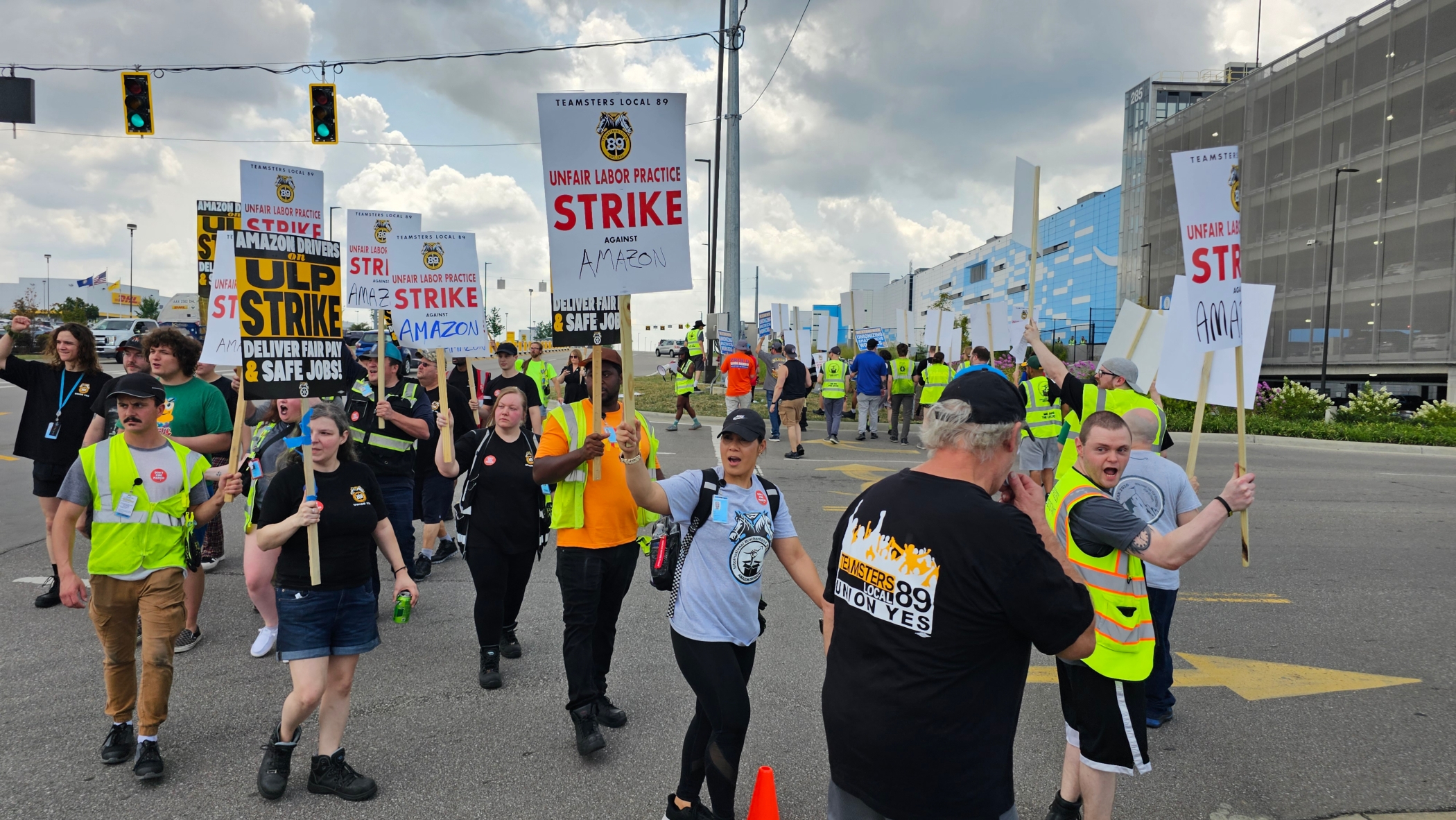
“Organizing our immigrant coworkers and taking on their struggles in a serious way is a necessity to organize Amazon everywhere.”
We publish this Interview made in December 2025 by Hans, organizer at Amazon in Germany and part of Amazon Workers International, with Ian Rivero, an Amazon KCVG worker organizing with the Teamsters and a member of socialist alternative.
The arrival in power of the Trump administration and its new right-wing friends from the digital economy implies enormous changes in the US and the global system in many aspects of our lives, like climate change, war, and the rights of migrants. We fear that some developments in the US will sooner or later threaten other countries, and especially their working classes, as well. We should be prepared! That is why we should get in contact with our colleagues in the USA. I discussed with Ian Rivero about how Trumpism changed the conditions of class struggle using Amazon as an example. Ian worked until recently at the world’s largest Amazon Airhub, KCVG, in the state of Kentucky, and he is a member of the International Brotherhood of Teamsters and Socialist Alternative. I met him at the Amazon Workers International meeting in Leipzig in April 2025. The interview took place in December 2025. We discussed the situation of migrant workers, the right turn of US unionism, how ICE affects migrant workers’ organization, and political reactions on the shopfloor level in the current situation. Ian’s workplace is very important for the global Amazon network because 30 per cent of global Amazon goods pass through the Airhub. In a state, Kentucky, where Trump received more than 60 percent of the vote, the site has an extraordinary workforce composition: Fifty percent of the workers at the site are white Americans, mainly from rural parts of Kentucky, while a significant group of migrants from African countries like Somalia, Congo, and Mauritius also work there. A total of between 3,500 and 4,000 workers are employed at the site.
Hans: Could you report to us more generally about the current union drive at your workplace and how migration has impacted your repertoire of tactics?
Ian: Our general goal is to found the union and get recognition. We have been campaigning for three years before affiliating with the Teamsters for a union. And as a result of this three-year fight, we have increased pay from $18 an hour to now $23.00 an hour. There’s always a fight that pops off in Amazon. We were definitely involved in a lot of the fights against religious discrimination and immigrant discrimination, especially around the African communities. We became very close with them.
I think the translation campaign was definitely a historic thing that we did. Bringing non-immigrant and immigrant workers together to win translations in over 100 languages and dialects, and really give a great kick start to this campaign. At Amazon, we have a lot of safety concerns. A problem is that migrant workers are not properly taught the safety instructions, as English is not their mother tongue. Two years ago, we were able to form a campaign to fight for translation rights for our immigrant coworkers, both as a health concern to keep us safe at work and as a means of bringing more immigrant workers into the union struggle, who may have had hesitations about joining a fight in a new country. During this fight, we were able to get over 1000 coworkers to sign a petition to get translations in 100 languages and dialects for all the safety regulations and all the trainings. And some of the workers who were able to gather petitions for this campaign were white Kentucky Trump-supporting workers. So, we were able to cut through even Trump’s divide-and-rule tactics.
Another campaign was the fight for prayer rooms at the workplace for our large group of Muslim co-workers. Amazon gives them this kind of tiny cubicle. You can only fit a few people in there. It’s not really fitting for coworkers whose religions practice communal prayers. However, there are a lot of religious people. When they pray, they have to wash their hands and feet in water. At Amazon, workers are forced to wash their hands and feet in the bathroom sinks, which is very humiliating and creates divisions between the native workers who are not used to seeing this and religious immigrant workers. Amazon will never fix this on its own. So, we gathered petitions to support our co-workers, started doing community meetings with our Muslim co-workers and halal restaurants every week outside of the airhub where we would plan, make actions, and discuss our grievances and concerns with Amazon, and bring new workers into the union struggle. Finally, we did not just fight for prayer rooms. We expanded the fight to end all discrimination, including hiring discrimination, and an end to seasonal hiring. We won the battle for the prayer rooms, but the fight to end discrimination at Amazon is still ongoing.
Let me add a third example. We had historic snowstorms in Cincinnati in 2025. That prevented a lot of workers from coming to work. They were snowed in, basically. One white worker from Kentucky couldn’t leave for work. Amazon excused his day. They said they wouldn’t take his UPT hours (unpaid leave) away. When he came back the next day, Amazon announced that they had taken his hours and would fire him in the next 24 hours. Now, there was a group of mainly 30, almost entirely African workers, who, within a very short amount of time, like an hour or two, gathered up and stood up for this worker, marched into HR, and demanded that this worker keep his job. They did that two days in a row, and on the second day, Amazon gave in to the pressure, and this white Kentucky native non-immigrant worker had his job saved by the collective actions of his African immigrant co-workers. They fought for him because they knew that we were all in the same union together, and an injustice to one is an injustice to all.
Hans: There were many very inspiring examples. Generally, how does Amazon reacts on your union drive? Have you observed tactics being used on your site to pit ethnic groups against each other? Is the ethnic separation an obstacle?
IR: Definitely, I don’t think it’s a barrier, but Amazon is smart, and they know that they can use divisions to basically keep workers from coming together collectively and fighting for their common interests. Many slogans are coming from Trump at the moment, like “migrants are coming in, stealing our jobs, and these jobs belong to the American working class”. That debate splits the working class. However, obviously, it’s Amazon that exploits and underpays the American working class people as much as possible. Getting a union together in places that are not unionized requires the whole workforce coming together and fighting for common demands. Teamster leadership must take on immigrant organizing in a very serious way, which also means fighting against the far-right backlash that we’re seeing all over the world now against immigrants, and taking on ICE in the workplace.
Hans: Could you tell us more about the current right turn of the Teamsters leadership? Teamsters leader Sean O’Brien appears publicly with representatives of MAGA and praises the Trump administration.
IR: The Teamsters is a very complex kind of union. Sean O’Brien’s election did a lot of good to fix the Teamsters. Today, the leadership is more willing to organize strike actions than before. There is a growth of the far-right influence across the whole world, and not just Teamsters, but also UAW leadership, and also other major union leaders cower before Trump and refuse to take the offensive by fighting back with their own political ideas. They kowtow before Trump and are trying to work with him rather than against him in hopes that this will keep us safe. Especially Sean O’Brien, the leader of the Teamsters, is cozying up with Trump and the anti-immigrant rhetoric of fighting only for the “American worker”, which is just code for a white non-immigrant worker. It is very easy for Amazon to then go to immigrant co-workers and say, “Look at what the union leaders are saying. This isn’t somebody you want to associate with. This is something that can put you in danger. The union is racist.”
Having a weak stance on defending immigrant workers creates an opening for Amazon to exploit. Amazon knows this. They will take advantage of it. I even heard a story where, in a mainly Hispanic facility, workers were told rumors by anti-union activists that they could be deported if they supported unionizing. Amazon will take advantage of any fear. Union leaders who are afraid to take on organizing immigrant coworkers are aiding the company. I think that organizing our immigrant coworkers and taking on their struggles in a serious way is a necessity to organize Amazon everywhere.
Hans: What should unions do in the current situation to save workers from ICE deportations?
IR: ICE is a challenge that affects us all. I will begin with the situation at KGVC. When ICE was raiding workplaces, it conducted a raid on a nearby Amazon site to us. Immediately, we got all of our immigrant co-workers together, creating a group chat as a way of informing each other and establishing a warning system in case there are any ICE raids or anyone knows anything. Some colleagues don’t show up to work that day. It’s happening to workers who are immigrants and workers who are not; everyone faces the possibility of detention if the far-right continues to grow unchallenged by labor. It’s really scary, and it’s having a slow-down effect on union organizing, particularly because unions are not taking up anti-ICE struggle seriously, which is pushing workers away more. I think getting our union locals to adopt anti-ICE resolutions and defense resolutions officially is important. In Chicago, a couple of weeks ago, when ICE tried to detain workers in their workplaces, the community built a wall around the workers and refused to let ICE abduct them, and they couldn’t be arrested. We can do the same thing in our workplaces, right? If our co-workers lock arms and refuse to let ICE take somebody. We sent a powerful message to ICE and to Amazon that we won’t back down! These are the exact things that historically unions have done for their members and are capable of doing now. It starts with us talking to our co-workers, challenging our unions, and having official resolutions.
Hans: The Teamster leadership and other union leaders turned to the right. What is Amazon? The company was interpreted as a company following the ideas of a progressive neoliberalism. How would you describe the relationship between Amazon and the Trumpist government project?
IR: This we-are-the-friendly-progressive-company is dying down. And what we’re seeing is more of a company that rules through fear, control, state repression in a very close cooperation with the right-wing government. Immediately when Trump took office, Amazon removed from its mission statement any phrasing about “fighting discrimination against black and LGBTQ+-identities“. That was removed, basically, because they don’t want to sound too woke. It’s not as important to them anymore, now that we have people like Trump in power. This shows that the only reason they were ever doing that was just to placate. Now, they are cozying up to Trump, making deals with him. For example, there was a scandal that Amazon was going to increase prices to make their money back from the tariffs. Trump immediately called out Amazon, and Amazon caved in and said, “No, they were never going to do that.” So, we can definitely see that the company seems to have a requirement to be very friendly and close to the state government to receive its own protection in a very significant way. The company needs a second-class wave of immigrants to exploit, and so they’re kind of taking advantage of the situation, too. Before I left, I was seeing on the A-Z-app – it is the app that we used to log on and see our schedules at Amazon – Amazon was also offering lawyers to help you if you wanted to get a green card to get your documentation well. It’s very curious, right? It’s what we’re seeing as a whole in Trump’s politics, where their goal isn’t to just wipe out all immigrants because then they need people to be divided into different ultra-exploited categories. Basically, their goal is to have more control and exploitative access to these immigrants. So, Trump will look the other way for Amazon offering a path to documentation for their workers because that helps Amazon keep workers under the company’s boot. Italso keeps workers fearful of joining a union. So, Amazon is very carefully manoeuvring this: Both getting closer to Trump but also trying to preserve their very easily exploited workforce.
Hans: Let’s wrap this up. How should the union or the workplace militants act against the rise of the right-wing forces? What can we in Europe learn from your struggle experiences?
IR: I think the solution to this is not going on the defensive and saying let’s kick out the immigrants and hope somehow this is going to pay us more, but rather going on the offensive and recognizing that it is not good for our union. It’s not good for working people to have a second class of workers. We should fight on the offensive for citizenship and documentation for everyone, legal rights to work for everyone, and unions should actively take up defending undocumented immigrants with unclear work restrictions. By doing this and increasing the livelihood and the rights of immigrants as well as our coworkers, we eliminate that second-class distinction and undercut the boss’s ability to underpay some of us more than all of us. In doing so, we bring those immigrants to our side. Immigrants might have some more fears about joining unions. We can extend the reaching hand and show, “We have the same enemy. Join the union, join the picket line, and fight with us, and you know we’ll fight with you.” I think whether we like it or not, unions have to take on a kind of standing up for the rights of immigrants as workers’ rights. And many Trump supporters can see this basic fact and will join the struggle. But I think people’s ideas change not through really good arguments or anything, but rather when struggling together. You have to be in the same room, in the same picket lines. You have to be fighting for each other’s interests. That’s the first step, getting them in the same meeting, going to a restaurant, and getting the right-wing workers and the immigrants together talking about what they’re going to fight for, what the issues are in a real democratic discussion. And by fighting for those things together, people’s minds will be changed. At the same time, we have to do political education. It’s important for us to teach our co-workers why these divisive politics are not in our interest. The whole point of a union is, “We’re doing this collectively.” We can explain that ultimately, the goal of these right-wing people is to keep us from being able to work together collectively. That’s why they need to divide us from immigrants. That’s why they need more rules and regulations to keep us from unionizing. And not losing patience with them, I think, is going to be key to changing their minds. I think that’s really how we’re ultimately going to combat these right-wing ideas.