
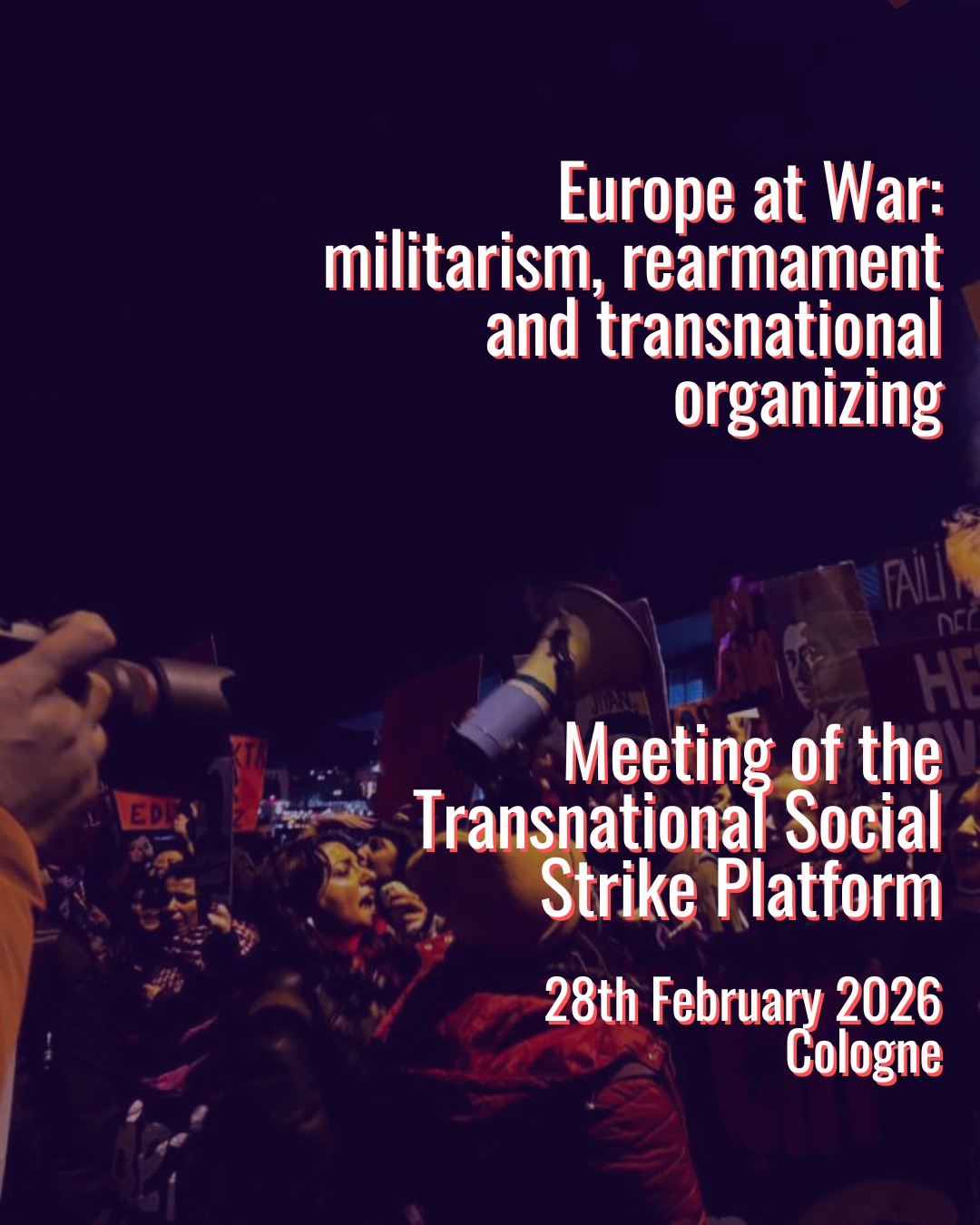
Meeting of the Transnational Social Strike Platform, 28th February 2026, Cologne (Germany)
This is an invitation to join the assembly that will take place in Cologne to build together our transnational organisation against Europe at war. In the last months, collectives from different countries that participate in the Transnational Social Strike Platform have met in Germany, Poland, and Italy to discuss how to oppose together the war and its social and political effects. For us, struggles against the war and struggles against exploitation and oppression are not separate, but the question of how to articulate them has no easy solution. The problem of how to build an opposition to the war, starting from how it impacts the social and living conditions of workers, migrants, students, women and lgbtq+ people, has to do with the transnational dimension of capital valorisation, of ideological preparation for war, of our struggles and of rearmament plans.
All the more in times of rising militarism, to cross national borders is a political anti-war act. We have to start to think again together and share a common understanding of what is going on, of what we have, and what we miss. For us, building organisational capacity and building a common discourse go hand in hand. Social movements in Europe have been divided over many issues, but especially about the war. The assembly in Germany will be the first of a series of meetings: now it is more important than ever to create moments of public discussion, keeping together the struggles in production and in social reproduction, to understand how to intervene against militarism and authoritarianism that are invading the social sphere, and to give more power to ongoing strikes and struggles against exploitation, institutional racism, patriarchal violence, and for climate justice. We want to create a place where we can strategically analyse what surrounds us. We want to address questions and doubts collectively, but also fears and uncertainties. We want to create a place where we can put together the puzzle pieces of “Europe at War”, positioning strategic and organizational considerations and their concrete manifestations into perspective. We want to find allies, we want to build new and stronger connections, we want to stand together against “Europe at War”.
Strikes against the war
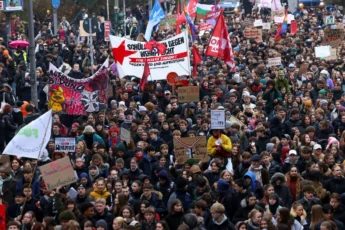
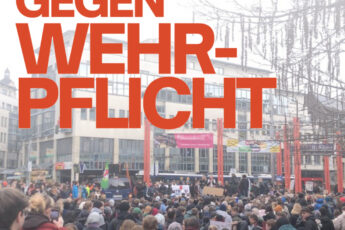
The idea of a strike against the war was unthinkable until recently, but things are changing. A few months ago, a wave of strikes and demonstrations blocked Italy, showing a widespread sense of urgency and rebellion against the genocide in Palestine and the whole logic of sacrifice imposed by the war, in the factories, in the houses, and in the schools. Albeit nowhere has this link been so direct, Italy is not an isolated case: in other countries, such as France and Greece, we have seen general strikes against austerity measures and increasing exploitation, which are also the product of an increase in military spending and rising militarism. Earlier this year, in Poland, workers of a German factory employing many Ukrainians went on strike to demand higher wages, thus challenging the fear of war used by the employers as a blackmail. In Germany, young students’ initiatives, together with established antimilitarist associations of conscientious objectors, started a wave of growing opposition to the German government’s plans to reintroduce compulsory military service. Other countries in Europe, such as Bulgaria and Slovakia, have been swept by unprecedented mass protests polarised by geopolitical alignments and budget choices.
These are signs that a rising discontent against the war is brewing. Still, this is not enough. The possibility of overturning this dire future made of war and violence will depend on our capacity to create long-lasting connections across borders, even when this seems impossible. This poses an organisational problem.
Everywhere struggles against exploitation and against racist and patriarchal oppression are somehow affected by the war, although not every struggle is affected in the same way. There are the people who are under the bombs or live under an ongoing occupation, in Palestine, Ukraine and elsewhere, who are paying the highest toll and whose demands for peace have to be met. There are workers, within and beyond the battlegrounds, who are facing economic hardships, lay-offs, social cuts and increasing exploitation, because the war is dictating the economic priorities of governments and capital. There are women and LGBTQ+ people whose freedom from violence and exploitation is increasingly under attack because the militaristic ideology demands obedience to patriarchal authority and sacrifice for the nation-state – in the houses, in the workplaces, in the schools, and in the streets – and fosters the brutal enforcement of this idea. There are migrants who are targeted by governments as the ‘internal enemy’ that has to be neutralised by curtailing freedom of movement, while, at the same time, their cheap labour is valued as essential for the distressed economy. Students in universities and schools are being censored, and their education is becoming increasingly geared towards the needs of the war effort.
The war is legitimising the right of the strongest and the indiscriminate violence among states and within states in the attempt to solve any contradiction and crush any opposition to capital’s transnational valorisation. While the cry to halt killings and destruction has risen loudly from the places where fighting is taking place, social movements have mostly avoided talking about peace, often divided by geopolitical logics and a warlike mentality. Somehow, the fragmentation and divisions that the war fuels have also permeated our political imagination.
Organizing within Europe at War
Against all of this, as TSS, we think that in order to build a transnational politics of peace, we need to discuss together how to side with those who struggle every day against the war in all its effects. This process builds upon the experience of the Permanent Assembly Against the War but looks beyond it. In this moment, organising our politics of peace requires that we face the fact that Europe is at war.
Europe is at war because its capitalist project and its military expansion have become inseparable. Europe is at war because Russia’s invasion of Ukraine has led to a large-scale military confrontation that has reshaped the economic, political, and military landscape. Europe is at war because of the rearmament plans of the European Commission, because some countries are debating the reintroduction of military conscription and because European governments keep on sending weapons to Israel, Ukraine and Sudan. Europe is at war despite the deal that may be reached in Ukraine. Europe is at war, and this is one of the faces the Third World War takes, as the violent attempt to regulate the transnational movements of labour. The war regime goes in fact beyond military spending and armies’ capacities, as it is affecting the very social and living conditions everywhere. Europe is at war because new industrial plans are reshaping the working conditions of millions of workers; because schools, universities and hospitals are asked to train people to get ready for military scenarios; because patriarchal policies are trying to push women to their ‘natural roles’, because racist violence is making the lives of migrants harder inside and across the borders.
An opposition to the war is possible, and the strike can break the fear. But we need to understand the ways in which the war is shaping our local realities and find ways to channel the collective refusal that is brewing across society into a joint struggle against the conditions imposed by a Europe at war. As TSS we open a process of collective discussion and organising, in different countries, on Europe at war, the challenges it poses to us, and the possibilities we still have. This is an invitation open to collectives, trade unions, political groups, and individuals who think the time is ripe to bridge our differences and organise collectively against the war.
See you in Cologne, Germany, on the 28th of February 2026! A detailed program of the event will be released in January. In the meanwhile, for further info contact us at info@transnational-strike.info